

Updated as of June 2026. Model availability, pricing, language support, and Vozo product details were checked against official pages where available.
Large language models have completely transformed translation technology over the past few years. But here’s the thing—choosing the best LLM for translation isn’t straightforward at all. Each AI model excels in different areas.
Some handle technical terminology flawlessly but completely miss cultural nuance in creative content. Others dominate high-resource Asian languages whilst struggling with European language pair subtleties. Pick the wrong translation model and you’re looking at wasted budget and potentially embarrassing mistranslations that could genuinely damage your brand reputation.
We tested the leading LLMs for translation across multiple language pairs using established metrics like BLEU, COMET, and professional translator evaluations—not just automated scores. Our rankings balance translation accuracy, language coverage, processing speed, cost efficiency, and specialized capabilities to help you choose the best LLM model for your specific translation tasks and use cases.
For teams localizing YouTube videos, product demos, training content, or creator-led campaigns, text translation quality is only one part of the workflow; dubbing quality, voice cloning, lip sync, subtitles, and on-screen text translation can matter just as much.
8 Best LLMs for Language Translation in 2026
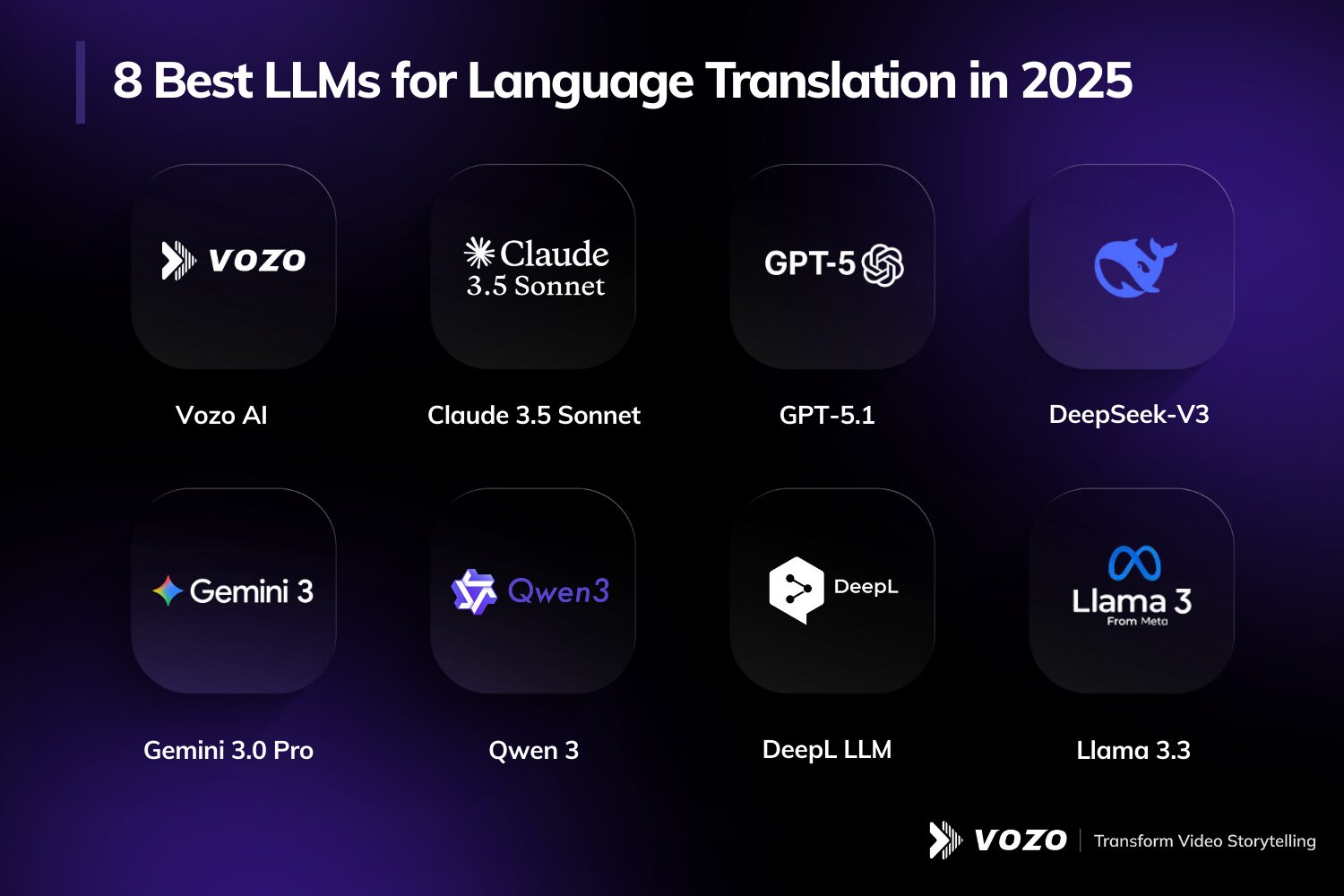
We evaluated each platform based on translation quality from professional assessments, multilingual coverage, processing efficiency, cost structure, and domain-specific features like technical terminology handling or creative content adaptation. The top LLMs serve different use cases, from rapid marketing videos to comprehensive technical documentation and translation and localization projects.
1. Vozo AI
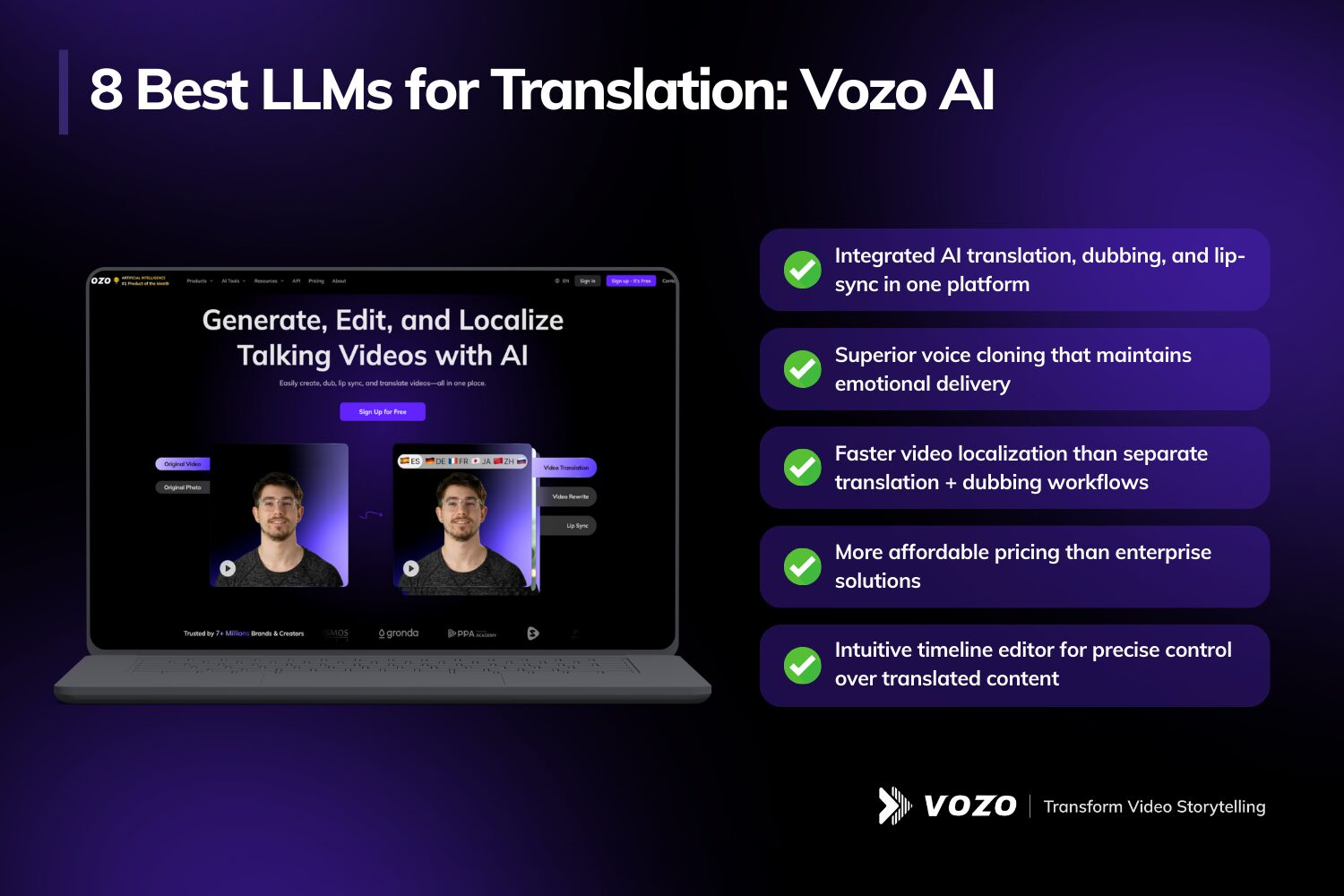
Best for Video Translation & Dubbing
Vozo AI takes a different approach than traditional translation tools by combining advanced LLM translation capabilities with complete video localization. While other platforms focus mainly on text, Vozo AI gives creators, marketers, educators, and global teams an integrated way to translate video content into 160+ languages, with current Translate & Dub support listed as 111 source and 165 target languages.
The platform leverages leading AI translation technology and pairs it with proprietary LipREAL™ lip sync technology that creates realistic mouth movements synchronized perfectly with translated audio. Content creators can choose VoiceREAL™ for expressive voice cloning and VoiceNATIVE™ for more natural native-language delivery, helping translated videos sound less like direct machine dubbing and more like content made for the target market.
For example, a SaaS marketing team can localize an English product walkthrough into Spanish, Portuguese, Japanese, and German inside one workflow: translate the script, generate natural dubbing, preserve the speaker’s voice, align lip movements, and edit subtitles or on-screen UI text before publishing localized versions to YouTube, landing pages, or paid social campaigns.
Where using LLMs for translation typically requires separate steps for text conversion, audio recording, and video synchronization, Vozo AI handles the entire workflow in one integrated platform. The WYSIWYG timeline editor gives users granular control over timing, delivery, and emotional nuance. Marketing teams save significant time by adapting existing video content for global audiences without managing multiple translation engines or vendors.
Vozo has a free plan with 20 AI points for trial use. Paid plans currently start with Creator at $29/month, including 150 AI points, roughly 50 AI dubbing minutes, 15 lip sync minutes, and 15 visual translate minutes; Studio starts at $99/month with 600 AI points and higher usage limits.
| Strengths | Limitations |
|---|---|
| ✅✅ 111 source and 165 target languages for Translate & Dub ✅ VoiceREAL™ and VoiceNATIVE™ options for expressive or native-sounding dubs ✅ Superior voice cloning that maintains emotional delivery ✅ Faster video localization than separate translation + dubbing workflows ✅ More affordable pricing than enterprise solutions ✅ Intuitive timeline editor for precise control over translated content | ❌ Video-focused rather than general text translation ❌ Learning curve for advanced editing features ❌ Processing time increases with longer videos ❌ Requires video content rather than standalone text |
2. Claude Sonnet 4.6
Best for Professional Translation Quality
Claude Sonnet 4.6 is a strong choice for professional translation workflows where tone, context, and long-form consistency matter. It is especially useful for marketing copy, editorial content, and document-level translation where literal accuracy alone is not enough.
This translation model excels at preserving tone, style, and subtle emotional nuances that make content feel native rather than translated. Its massive context window handles long documents while maintaining consistent terminology and style throughout. Claude particularly shines with European languages and literary translation where capturing voice and personality matters as much as translation accuracy, understanding context and adjusting phrasing to feel natural in the target language.
Claude Sonnet 4.6 is currently priced at $3/MTok input and $15/MTok output on Anthropic’s first-party API.
| Strengths | Limitations |
|---|---|
| ✅ Highest professional translator ratings ✅ Strong long-context handling for document-level consistency ✅ Superior tone and style preservation ✅ Large context window for document-level consistency ✅ Excellent with nuanced creative content | ❌ Higher API costs than some alternatives ❌ Slower processing speed than lightweight models ❌ Less specialized for highly technical terminology ❌ Requires careful prompt engineering for optimal results |
3. GPT-5.5
Best for Consistent Universal Performance
OpenAI’s GPT-5.5 is the current flagship option for teams that want a high-end general-purpose model for translation-adjacent workflows, including terminology rewriting, localization QA, and multilingual content adaptation.
As of June 2026, OpenAI lists GPT-5.5 at $5.00/1M input tokens, $0.50/1M cached input tokens, and $30.00/1M output tokens. For lower-cost workflows, GPT-5.4 or smaller GPT models may offer better price-performance.
| Strengths | Limitations |
|---|---|
| ✅ Most consistent quality across all language pairs ✅ Lowest performance variance in benchmarks ✅ The model is broadly multilingual, but OpenAI does not present it as a fixed-language translation product in the same way dedicated translation platforms do. ✅ Excellent API integration options ✅ Reliable for agent-based workflows | ❌ Highest API pricing among major LLMs ❌ Slower processing than specialized models ❌ Less exceptional in specific pairs vs. specialists ❌ Generic approach may miss domain-specific nuances |
4. DeepSeek V4 Flash / V4 Pro
Best for Technical & Code Translation
DeepSeek’s current API lineup lists DeepSeek-V4-Flash and DeepSeek-V4-Pro, both with a 1M context length and up to 384K max output. For translation workflows, this makes DeepSeek especially attractive when teams need low-cost high-volume processing, technical content handling, or long-context localization QA.
Current official API pricing is listed at $0.14/1M cache-miss input tokens and $0.28/1M output tokens for V4 Flash, and $0.435/1M cache-miss input tokens and $0.87/1M output tokens for V4 Pro.
| Strengths | Limitations |
|---|---|
| ✅ Highest benchmark score (9.28) for translation ✅ Superior technical and code translation accuracy ✅ Excellent English-Chinese performance ✅ Open-weight model allows local deployment ✅ Strong logical reasoning for complex content | ❌ Requires substantial VRAM (24-48GB) for local use ❌ Less specialized for creative or marketing content ❌ Smaller community and documentation vs. GPT/Claude ❌ Model naming changed; deepseek-chat and deepseek-reasoner are scheduled for deprecation on July 24, 2026 |
5. Gemini 3.1 Pro / Gemini 3.5 Flash
Best for Multimodal Translation
Gemini’s current lineup is strongest when translation work includes multimodal context: PDFs, screenshots, charts, images, audio, video, and long documents. Gemini 3.1 Pro is positioned for advanced reasoning and complex multimodal work, while Gemini 3.5 Flash is positioned for frontier-class performance at lower cost.
| Strengths | Limitations |
|---|---|
| ✅ Handles images, tables, and visual elements in documents ✅ Strong performance in specific regional languages like Telugu ✅ Handles text, image, video, audio, and PDF inputs with text output ✅ Useful when translation depends on visual or document context ✅ Faster specialized Translation LLM variant available ✅ Enterprise infrastructure and customization options | ❌ Quality varies significantly by language pair ❌ High refusal rates for some rare languages ❌ Less consistent than GPT-5.1 across all pairs ❌ Multimodal features require higher API tiers |
6. Qwen 3
Best for Asian Languages
Qwen3, developed by Alibaba, remains a strong option for Asian-language translation and multilingual applications. Its official release notes list support for 119 languages and dialects, making it relevant for teams working across Chinese, Japanese, Korean, Southeast Asian, and broader multilingual use cases.
Where Western-trained models often struggle with Asian linguistic structures and cultural references, Qwen 3 handles them naturally, understanding Chinese idioms, Japanese honorifics, and Korean formal speech levels. As an open-weight model, Qwen 3 offers deployment flexibility for organizations with data sovereignty requirements, though the 72B parameter version requires significant computational resources (24-48GB VRAM).
| Strengths | Limitations |
|---|---|
| ✅ Dominant performance in Chinese, Japanese, Korean ✅ Exceptional handling of Asian cultural context ✅ Strong technical terminology in Asian languages ✅ Open-weight allows local deployment ✅ Maintains high accuracy in specialized domains | ❌ Less competitive for non-Asian language pairs ❌ Requires substantial computational resources ❌ Smaller English documentation community ❌ Limited Western language optimization |
7. DeepL LLM
Best for Professional Polish
DeepL’s next-generation LLM was introduced in 2024 and remains highly relevant for professional translation polish, especially where fluency, terminology control, and low post-editing effort matter.
DeepL’s hybrid approach combines neural machine translation (NMT) precision with LLM contextual understanding, balancing speed, accuracy, and natural language flow better than pure approaches. DeepL’s own documentation recommends checking the current /v3/languages endpoint for language support and feature availability such as formality, glossary, and auto-detection.
| Strengths | Limitations |
|---|---|
| ✅ Fewest edits required (2-3× less than GPT-4) ✅ Highest fluency ratings in supported pairs ✅ Ready-to-publish quality for professional content ✅ Excellent glossary and terminology control ✅ Hybrid NMT+LLM approach balances strengths | ❌ Limited language pair coverage ❌ Focus on EN-DE, EN-JA, EN-ZH only ❌ Higher cost than general translation APIs ❌ Less flexible for non-standard content types |
8. Llama 4 / Llama 3.3
Best for Open-Source Deployment
For open-weight deployment, Meta’s Llama family is now better framed as Llama 4 for the latest multimodal and long-context capabilities, with Llama 3.3 still relevant for text-focused open-source workflows where teams already have infrastructure and fine-tuning pipelines.
The model excels at long-context translation, maintaining consistent translation across entire documents rather than treating each paragraph independently. Running Llama 3.3 requires substantial hardware—48GB+ VRAM for optimal performance—but quantized versions reduce requirements to 16-24GB. Organizations can fine-tune the model for specific domains or terminology, creating specialized translation systems that outperform general-purpose APIs.
| Strengths | Limitations |
|---|---|
| ✅ Strong Chinese translation performance ✅ Excellent long-context document handling ✅ Open-weight allows complete customization ✅ No recurring API costs ✅ Can be fine-tuned for specialized domains ✅ Llama 4 Scout and Maverick support native multimodality and 10M-token context windows | ❌ Requires significant computational resources (48GB+) ❌ Setup complexity vs. API solutions ❌ Lower scores than top commercial models ❌ Needs technical expertise for deployment and optimization |
How to Choose the Best LLM for Your Translation Needs
Marketing content and creative materials benefit from Claude Sonnet 4.6 or Vozo AI’s video localization workflow. Technical and high-volume workflows should compare DeepSeek V4 Flash/Pro, GPT-5.5, Gemini 3.1 Pro or Gemini 3.5 Flash, and Qwen3 depending on language pair, cost, and deployment needs.
Consider your language pairs carefully. High-resource languages like English, Spanish, French, German, and Chinese work well across most top LLMs. Regional languages may require specific models—Gemini for Telugu, Qwen for Japanese, Claude for literary European content.
OpenAI’s flagship GPT-5.5 is premium-priced, Anthropic’s Sonnet 4.6 sits at $3/MTok input and $15/MTok output, DeepSeek V4 Flash is much lower-cost for high-volume API workflows, and Vozo starts at $29/month for integrated video translation, dubbing, lip sync, and visual translation workflows.
8 Best LLMs for Translation FAQs
Which LLM produces the most accurate translations?
Claude 3.5 Sonnet received the highest ratings from professional translators at 78% “good” evaluations, while DeepSeek-V3 scored 9.28 in comprehensive benchmarks. Accuracy depends on your specific language pair and content type. LLMs perform better than traditional neural machine translation on most benchmarks, though high-stakes translation for legal contracts or medical materials still requires human review for cultural nuance and quality assurance.
Do LLMs translate better than Google Translate?
Yes, modern LLMs outperform traditional translation tools like Google Translate in most benchmarks. The WMT24 competition showed LLMs winning 9 of 11 language pairs against specialized neural machine translation systems. However, Google’s NMT remains faster for simple text, while LLMs excel at context and using AI for domain-specific translation tasks.
What’s the best LLM for video translation?
Vozo AI specializes in video translation with integrated AI dubbing, lip sync, subtitles, voice cloning, and on-screen text translation. Its current Translate & Dub support is listed as 111 source and 165 target languages, commonly summarized as 160+ languages.
Back to Top: 8 Best LLMs for Translation | 2026 Performance Rankings
