
La scène mondiale : Stratégies de localisation des vidéos
Qu'est-ce que la localisation de vidéos ?
Video localization is the process of adapting video content to a specific market’s language, culture, and technical requirements so it feels native and delivers the same intent and emotion.
Idée maîtresse
Localization goes beyond swapping words. It adapts meaning, tone, visuals, references, and context to match local expectations. The goal is that the viewer feels the content was made for them.
Comment ça marche
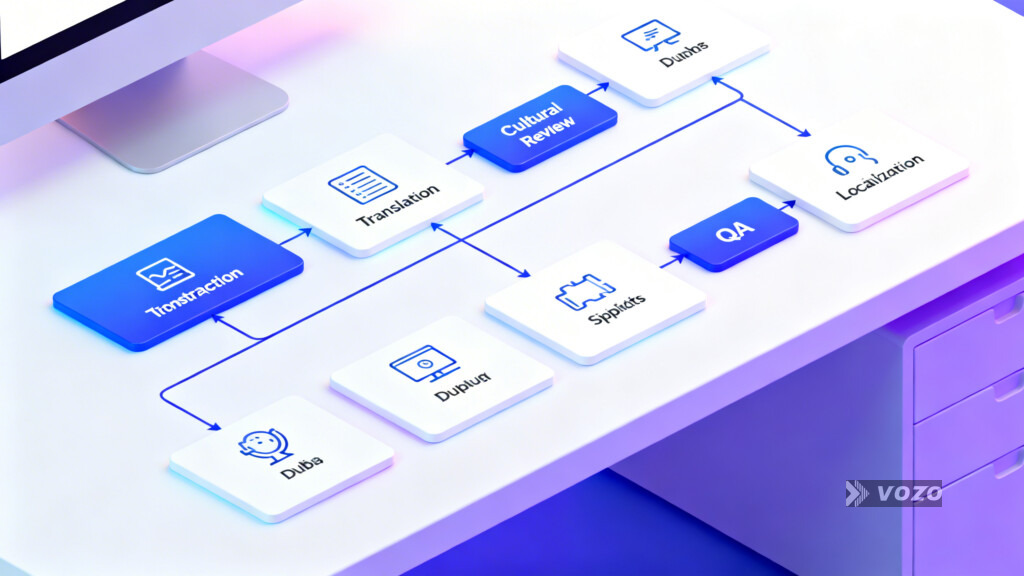
Most workflows include analysis, transcription, translation, cultural review, audio production (dubbing, voice-over, subtitles), visual edits, and quality assurance by native speakers. Deliverables are then packaged for each platform’s specs.
Domaines d'utilisation
Common use cases include entertainment, corporate training, marketing, education, news and media, and public service messaging. Any video that crosses borders can benefit from localization.
Pour qui ?
Businesses, educators, creators, and marketing teams use localization to reach international audiences. It also helps product teams and support organizations reduce friction for global users.
Why Video Localization Matters
In a world where videos are instantly discoverable across borders, simple translation is rarely enough. The best strategies for localizing video content for global audiences combine linguistic accuracy, cultural fit, and platform-ready delivery, often using AI to scale without losing quality.
Done well, global video content localization can unlock new markets, build loyalty, and lift conversion rates. Done poorly, it can create confusion, reduce trust, or even offend, especially when humor, symbolism, or sensitive topics are involved.
Historical Context: How Video Localization Got Here
Video localization has evolved from manual, expensive post-production work into a scalable discipline supported by modern tooling and AI, while still relying on human judgment for nuance.
Early days (pre-digital era)
Film dubbing and subtitling emerged with early cinema to cross language barriers in theatrical distribution. Everything was manual, relying on translators, voice actors, and editors. Because it was expensive and slow, only major productions could justify extensive localization.
Rise of television and home video (late 20th century)
International TV syndication and VHS and DVD expansion drove demand. Post-production tools improved audio and video synchronization, and localization agencies began specializing by region and language.
The internet and digital revolution (early 2000s)
Online distribution made video global by default. Platforms like YouTube and streaming services democratized creation and raised the need for faster, more scalable international video localization best practices. Early machine translation helped, but often lacked nuance.
AI and machine learning era (2010s to present)
Neural networks significantly improved machine translation and speech synthesis. AI-powered tools now support dubbing, voice cloning, lip sync, and subtitle generation at scale. The best results increasingly follow a human and AI symbiosis: AI accelerates production, humans ensure cultural accuracy and brand fit.
How Video Localization Works
Video localization is best understood as a production pipeline with checkpoints. At a high level, you start with a source video and end with one or more localized versions that match local language expectations, cultural context, and platform constraints.
Technically, this involves converting speech to text (transcription), translating and adapting the script, producing localized audio and or subtitles, editing visuals that contain language, then verifying the result with native speakers and technical QA.
The localization workflow: from source to target
Effective video localization strategies follow a repeatable pipeline:
- Content analysis: Review the source for linguistic complexity, cultural references, on-screen text, and technical constraints.
- Script transcription and translation: Transcribe dialogue accurately, then translate for meaning and intent.
- Cultural review: Adapt idioms, humor, references, and visuals for local relevance.
- Voice talent or AI selection: Choose voices (human or AI) that match tone, emotion, and demographic cues.
- Audio production: Record or generate audio, mix and master tracks, and create subtitles with correct timing.
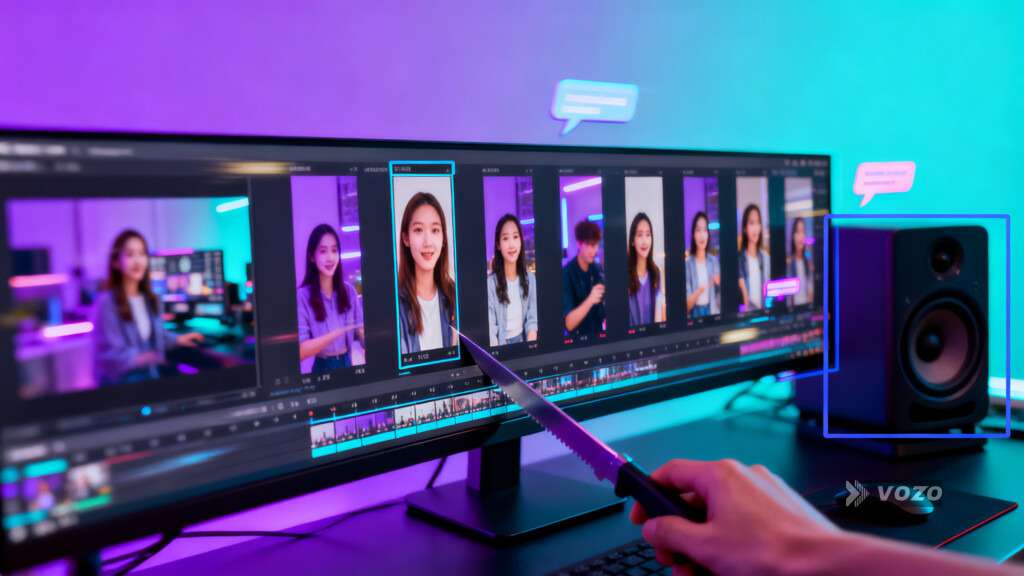
- Video editing and adaptation: Update on-screen text, graphics, and any market-specific visual cues.
- Quality assurance (QA): Native-speaker review for language accuracy, cultural appropriateness, and sync.
- Delivery and distribution: Export in the right formats, specs, and metadata for each platform and region.
Conseil pratique : Plan localization during pre-production. If you modularize content (separating voiceover, on-screen text, and cutaway shots), you reduce rework later and can swap regional elements faster.
Linguistic adaptation: beyond word-for-word translation
Translation quality is not just correctness, it is usefulness in context. A localized script should sound like something a native speaker would naturally say in that situation, with the same intent as the original.
- Semantic accuracy: Preserve meaning, not literal phrasing.
- Idiom and metaphor handling: Rewrite expressions that do not travel well.
- Dialect and regional nuance: Choose between a standard variant and a local dialect depending on audience and brand.
- Tone and register: Keep the same level of formality, humor, urgency, or warmth.
- Text expansion or contraction: Expect timing and layout changes in subtitles and graphics as languages vary in length.
- Grammar and syntax: Ensure natural sentence structure for the target language.
- Local SEO keywords: Localize titles, descriptions, and keyword choices for discoverability in-region.
Actionable workflow: Maintain a glossary and a “do-not-translate” list (product names, legal phrases, brand taglines). This improves consistency across episodes, campaigns, or course modules.
Cultural adaptation: connecting with the local heart
Cultural sensitivity is both a primary risk and a primary opportunity in localizing video content for global audiences. Even when the language is correct, the content can still feel foreign if visual cues, humor, or social norms do not match local expectations.
- Visual cues and imagery: Replace or adjust imagery that may confuse or alienate the local audience.
- Color symbolism: Colors can signal different emotions across cultures (for example, white can mean purity in some contexts and mourning in others).
- Gestures and body language: Some gestures do not translate cleanly and may be offensive.
- Humor and puns: Often require transcreation, not direct translation.
- Dates, times, currencies, units: Localize formats and measurements to local standards.
- Conformité juridique et réglementaire : Align with local advertising rules, content ratings, and disclosure requirements.
- Social norms and values: Be mindful of portrayals related to family, gender roles, religion, and politics.
Conseil pratique : Build a lightweight cultural QA checklist per region that includes taboo topics, compliance notes, and examples of preferred tone.
Technical aspects: ensuring seamless delivery
Even perfect language fails if the video does not play correctly or feels clunky. Technical localization makes sure the localized version meets platform expectations and regional requirements.
- Resolution and aspect ratios: Deliver in specs that match devices and platform norms, including vertical formats for shorts.
- File formats and codecs: Ensure compatibility across distribution channels.
- Audio mixing and loudness standards: Meet platform or broadcast requirements by region.
- Subtitle formatting: Timing, placement, reading speed, and style must be comfortable to consume.
- Metadata localization: Localize titles, descriptions, tags, and thumbnails for discovery.
- Digital rights management (DRM): Apply region-specific DRM where required.
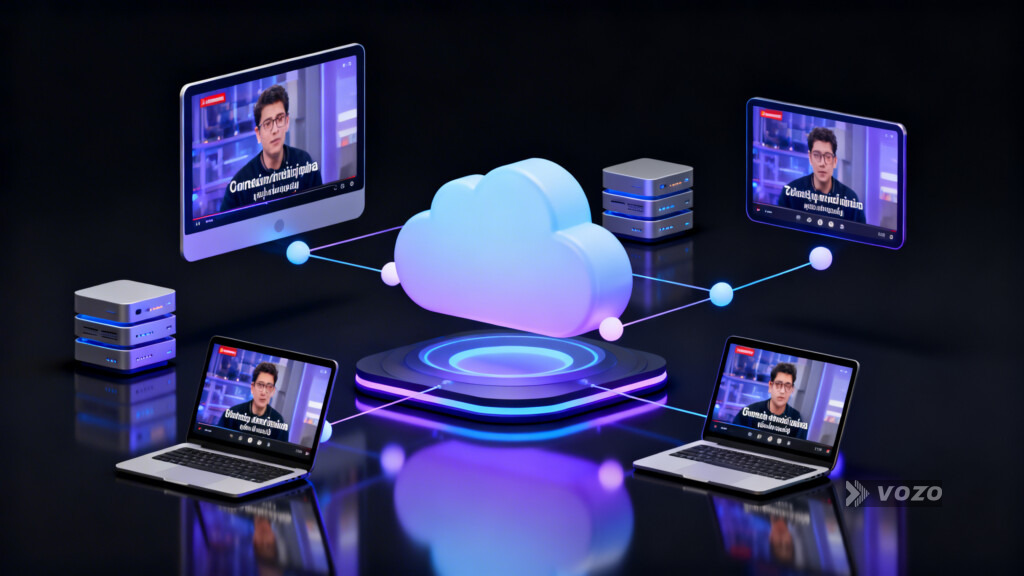
- Platform integration: Ensure smooth publishing across streaming services, social platforms, or local video sites.
Key Components of Video Localization
- Source evaluation: Identify what must change, including language, on-screen text, cultural references, and compliance risks.
- Language assets: Transcripts, translation memory, glossaries, and style guides that keep terminology consistent.
- Cultural review: Checks for relevance, appropriateness, and brand fit in each target region.
- Audio production: Dubbing, voice-over, or voice-preserving translation plus mixing and mastering.
- Subtitle production: Subtitle creation, SDH when needed, timing, line breaks, and reading speed controls.
- Visual adaptation: On-screen text edits, graphics updates, localized units and formats, and market-specific replacements.
- QA and sign-off: Native-speaker linguistic QA plus technical QA for sync, loudness, exports, and platform specs.
- Versioning and delivery: File naming, metadata, thumbnails, rights, and packaging for each platform and region.
Localization Methods and Enabling Technologies
There is no single best method for every market. The right approach depends on audience expectations, budget, content type, and how important emotional delivery is compared to speed and cost.

Doublage
Définition : Replacing the original dialogue with translated audio in the target language.
Advantages: A seamless experience, often preferred in entertainment, marketing, and children’s content. Types: Full dubbing, partial dubbing, and AI dubbing.
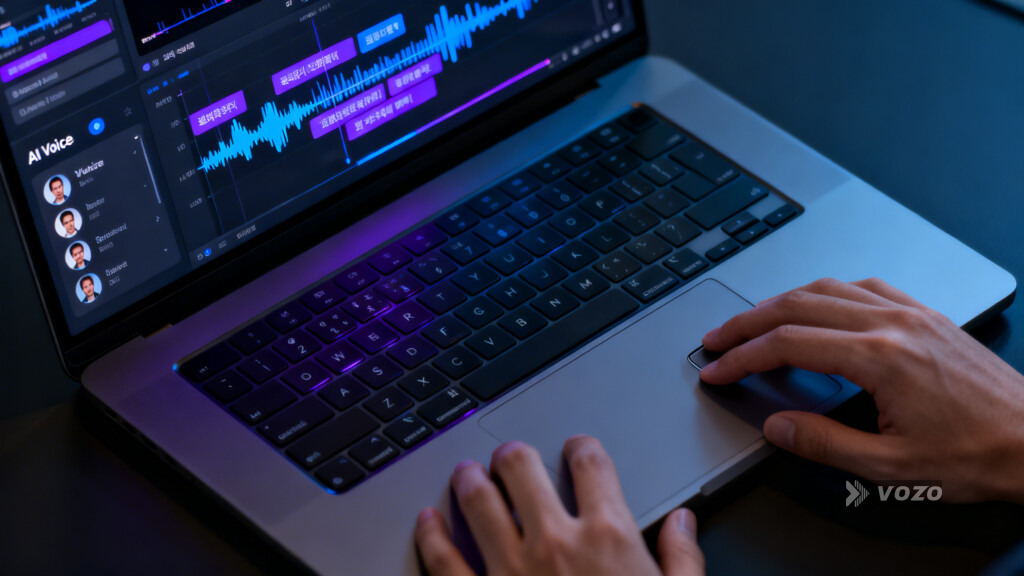
AI can significantly reduce turnaround time. Tools like Vozo AI Dubbing can auto-dub with voices that match tone, pacing, and emotion, supporting 60+ langues et 300+ lifelike AI voices, which can be helpful when localizing large content libraries.
Sous-titrage
Définition : On-screen translated text while keeping original audio.
Advantages: Cost-effective, preserves original performance, helpful for language learners, and improves accessibility. Types: Open captions (always on), closed captions (toggle), and SDH (sous-titres pour sourds et malentendants).
For creators moving fast, a mobile-first workflow can be a practical option. BlinkCaptions supports generating and refining captions and subtitles on the go.
Voice-over
Définition : Translated narration over the original audio, which is lowered but still audible.
Advantages: Preserves authenticity of the original speaker, common in documentaries, corporate training, and news.
If you need the speaker to still feel like the speaker, Vozo Audio Translator can translate audio while preserving the original voice, tone, and emotion, making voice-overs feel less generic.
Transcréation
Définition : Rewriting the message to produce the same emotional effect in the target culture, going beyond direct translation.
Where it matters most: Marketing campaigns, slogans, brand storytelling, and humor-heavy content. Reality check: This usually requires human cultural experts and creative writers, not just linguists.
Plateformes de traduction vidéo par l'IA
For end-to-end workflows, Vozo Video Translator supports AI-powered video translation into 110+ languages, natural dubbing, voice cloning with VoiceREAL™, optional lip sync with LipREAL™, plus a built-in proofreading editor for fast human refinement. This “AI draft plus human polish” model aligns with the human and AI symbiosis approach many localization teams now prefer.
Voice cloning (VoiceREAL™)
Voice cloning replicates a speaker’s voice characteristics in new languages. This can support brand consistency for founders, instructors, and recurring hosts, but it should be used with clear permissions and appropriate safeguards.
Lip sync (LipREAL™)
Lip sync aligns translated audio with on-screen mouth movements, reducing the classic dubbing effect and increasing immersion. For teams that already have audio and video tracks, Vozo Lip Sync is a focused tool designed for accurate, natural mouth movement matching, including interviews and multi-speaker scenes.
Text-to-speech (TTS) and speech-to-text (STT)
STT powers transcription and TTS powers synthetic voice generation. Together they form the base layer of automated dubbing and subtitling, and they can dramatically reduce the time from source content to a localized draft.
Content editing and repurposing tools
- Vozo Voice Studio (Réécriture vidéo) lets you rewrite and redub voiceovers with a text-based editor, without re-recording.
- Vozo Long to Shorts (Shorts Generator) converts long videos into 10+ short clips with AI virality scoring and auto-reframing, which can be useful for localized social campaigns where different markets respond to different hooks.
Talking Photo AI
Vozo Talking Photo turns a static photo into a speaking character with natural gestures and accurate lip sync, useful when you need localized spokespeople without new shoots.
Developer APIs
For scale and customization, Vozo API enables integration of translation, dubbing, lip sync, and video capabilities into your own platform and workflows (also available via AWS Marketplace). This is particularly useful when you need programmatic localization across many assets.
Exemples concrets
Example 1: Streaming entertainment releases
A global streaming service launches a new series with multiple audio tracks and subtitles on day one. The localization team combines dubbing for markets that prefer it with high-quality subtitles elsewhere, while also localizing on-screen text, content warnings, and metadata so the show is discoverable in each region.
Example 2: Corporate training and compliance
A multinational company localizes onboarding and compliance modules for employees across regions. Voice-over or dubbing is paired with localized on-screen labels and region-specific policy references, then native-speaker QA checks terminology consistency, clarity, and legal accuracy.
Example 3: Performance marketing campaigns
A brand adapts a product launch video for several countries, using transcreation to match local humor and buying motivations. Visuals and claims are reviewed for local advertising rules, and captions and thumbnails are localized for platform search behavior in each market.
Example 4: Public service messaging
A public health agency distributes critical guidance in multiple languages with accessible subtitles and clear voice-over. The team localizes measurements, dates, and contact information, then validates comprehension with community reviewers to avoid ambiguity.
Industry Use Cases and Where Localization Shows Up
Entertainment industry
- Hollywood blockbusters (for example, Marvel films) are dubbed into many languages for theaters and streaming.
- Anime is often subtitled and dubbed, with cultural adaptation for different regions.
- Gaming localizes cinematics, dialogue, and on-screen text for immersion.
- Streaming services like Netflix and Disney+ offer multiple audio tracks and subtitles to serve global subscribers.
Corporate and business communications
- Marketing and advertising: Global brands like Coca-Cola and Apple localize launches and commercials to match local culture and buying motivations.
- Training and e-learning: Multinational companies localize compliance and onboarding videos.
- Customer support: Localized explainers reduce tickets and improve satisfaction.
- Investor relations: Earnings calls and presentations are often localized for international stakeholders.
Education and e-learning
- MOOCs: platforms like Coursera and edX localize lectures to reach global learners.
- Educational documentaries: adapted for different countries with voice-over or dubbing.
- Language learning apps: localized videos provide contextual learning.
News and media
- International outlets localize interviews and documentaries for broader distribution.
- Broadcast journalism uses voice-over or interpretation for major events.
Government and public service
- Public health campaigns use localized video to reach diverse communities.
- Tourism boards localize promotional videos for priority visitor markets.
- Official communications are localized for immigrant and foreign resident populations.
Avantages et limites
Avantages
- Market expansion: Localization is a gateway to new audiences and regions.
- Higher engagement: Culturally native content often improves watch time and completion.
- Brand loyalty: Viewers feel understood when language and context fit.
- Better conversions: Localized messaging can improve conversion rates by reducing friction and uncertainty.
- Fewer risks: Cultural review helps avoid miscommunication or offense.
Limites
- Cultural nuance is hard to automate: AI can struggle with humor, idioms, or sensitive topics without guidance.
- QA is non-negotiable: Even strong AI outputs need native review for professional or brand-critical content.
- Costs rise with complexity: Multi-speaker scenes, heavy on-screen text, or strict compliance requirements add work.
- Operational overhead: Managing multi-language versions, metadata, and platform packaging requires process discipline.
How to Measure Localization Impact
Localization is easiest to improve when it is measured. Instead of relying only on qualitative feedback, track performance by region and by localization method.
- Watch time and completion rate: Signals whether the localized experience holds attention.
- Interactions: Likes, comments, and shares can reveal whether tone and cultural fit landed.
- Comprehension: Surveys, quizzes, or support outcomes help validate clarity for training and education.
- Preference feedback: Track whether viewers choose dubbing or subtitles when both exist.
- Regional traffic and conversions: Measure impact on signups, purchases, or other business outcomes.
- Market penetration over time: Look for sustained growth, not just a short spike after launch.
How Video Localization Compares to Alternatives
Video localization is sometimes confused with translation or treated as “just subtitles.” The differences matter because they affect risk, quality, cost, and audience response.
| Aspect | Video Localization | Simple Video Translation | Transcréation |
|---|---|---|---|
| Scope | Language, culture, visuals, and technical delivery are adapted to feel native. | Primarily converts words from one language to another. | Rewrites for the same emotional effect, often with major creative changes. |
| Coût | Medium to high depending on dubbing, visual edits, and QA depth. | Lower, especially for subtitles only and limited QA. | Often high because it requires creative and cultural specialists. |
| Complexité | High, because it includes multiple assets and deliverables (audio, captions, graphics, exports). | Low to medium, but risk rises when context and visuals are ignored. | High, because success depends on creative judgment and brand understanding. |
| Meilleur pour | Most professional global distribution, including entertainment, marketing, training, and public messaging. | Fast, informational content where perfect cultural fit is not critical. | High-stakes marketing, slogans, humor-heavy scripts, and brand storytelling. |
A Practical Path to Global Reach
The best strategies for localizing video content for global audiences treat localization as a full-stack discipline: language, culture, and delivery specs working together. Start with a solid workflow, choose the right method (dubbing, subtitling, voice-over, transcreation), and use AI to scale while keeping humans in the loop for nuance and brand safety.
If building a repeatable localization pipeline is the goal, tools such as Vozo Video Translator can support end-to-end rollout with broad language support, voice cloning, optional lip sync, and a built-in proofreading editor. Regardless of tooling, the most reliable programs standardize glossaries, QA checklists, and export requirements so quality does not drop as volume grows.
Questions fréquemment posées
What is the primary difference between translation and localization for video?
Translation converts words. Localization adapts the entire experience, including language, culture, visuals, and technical delivery, so it feels native to the target audience. In practice, localization aims to preserve intent and emotion, not just meaning.
Is AI localization good enough for professional content?
Often yes for many business and educational use cases, especially as a first pass. For critical marketing, sensitive topics, or highly creative scripts, a hybrid approach with native human review is usually the safest path. QA remains essential even with strong AI.
How do you choose between dubbing and subtitling?
Consider audience preference (some markets favor dubbing, others subtitles), budget, content type, and desired emotional impact. Entertainment often benefits from dubbing, while education and news often work well with subtitles. Also account for how much on-screen text must be localized.
What is lip sync and why is it important in video localization?
Lip sync matches translated audio to on-screen mouth movements. It boosts realism and immersion, and it reduces the dubbing effect that can make localized videos feel distracting. It is especially noticeable in close-up interviews and dialogue-heavy scenes.
Can you localize existing videos without re-recording everything?
Yes. You can dub, add subtitles, or produce voice-over without changing the original footage, and you can also edit on-screen text if needed. Tools like Vozo Voice Studio (Réécriture vidéo) support text-based rewriting and redubbing so updates can be made without a full re-shoot.
How can you ensure cultural sensitivity in localized videos?
Use native-speaker QA and consult cultural experts for priority markets, especially for marketing and sensitive topics. Research local norms, avoid direct translation of humor and idioms when needed, and treat transcreation as a planned step rather than a last-minute fix. A proofreading editor in the workflow can also help catch issues early.
What are the benefits of using an API for video localization?
An API like Vozo API lets teams integrate translation, dubbing, and lip sync directly into internal tools for automation and scalability. This is useful for high-volume pipelines where localization must be programmatic and consistent. It can also enable custom QA, routing, and versioning logic.
How can you turn a long video into short, localized clips for social media?
Use a repurposing tool like Vozo Long to Shorts (Shorts Generator) to generate multiple clips, then add localized dubbing or subtitles per market. This approach supports testing different hooks in different regions and scaling what performs best. Make sure each clip’s captions, on-screen text, and metadata are localized too.