

Ecommerce Video Localization ROI Explained
What is ecommerce video localization ROI?
Ecommerce video localization ROI is the measurable revenue and profit gained when you adapt product videos for specific languages and cultures, compared with the cost of translating, dubbing, and updating those videos.
Ideia central
Localize a proven product story once, then scale it across markets so the video feels native. That typically means translating audio, captions, and any on-screen text that affects understanding and trust.
Como funciona
Start with a high-performing source video, translate the script, and produce localized subtitles or voice tracks. Then adapt visuals such as currency, measurements, and UI language, and run QA before publishing.
Onde é utilizado
Common placements include product pages, paid social ads, marketplaces, live shopping clips, and email embeds. It also shows up in post-purchase onboarding and support workflows where clarity reduces returns.
A quem se destina
E-commerce brands, performance marketers, growth teams, marketplaces, and any team selling cross-border or expanding into new language regions benefit most. It is especially valuable when products require explanation, setup, or trust.
International growth is rarely blocked by product quality. It is blocked by comprehension and trust. A shopper might like what they see, but if sizing, setup steps, guarantees, delivery details, or returns feel unclear, the cart stays empty.
That is why ecommerce video marketing is increasingly tied to localization, not just production value. In 2026, a big share of video viewing is already global: one industry report notes that 40% of YouTube views come from non-English-speaking audiences (Verbit). When your best-performing product video only exists in English, you are effectively paying to create demand you cannot fully convert.
Why Localized Product Videos Change ROI Math
Video already boosts performance in e-commerce. A 2026 industry write-up reports that product pages with video convert 80% higher than pages without video (PixelMotion). That is before you add language fit.
Now combine that with how people buy across borders. A global content strategy report summarizes widely cited consumer behavior: 75% of consumers prefer to buy in their native language, e 60% rarely or never purchase from English-only websites (GetBlend). Another localization ROI resource cites similar findings, including that 40% of consumers will not buy from websites in other languages e 76% prefer product information in their own language (Translated.com, citing CSA Research).
Put simply: strong video increases conversion, and native-language experiences reduce friction. Together, they drive the translated product video sales impact that teams can actually measure.
What “Video Localization” Means (Not Just Subtitles)
Many teams start with subtitles, which can be a smart entry point. But true localization often includes adapting what viewers read, hear, and infer from the visuals, so the video feels built for the market rather than translated for it.

Language conversion
- Subtitles (translated captions): Fast to produce and easy to test across markets.
- Dubbing (new audio track): Often increases trust for demos and mid-funnel viewing.
- Voice matching for brand consistency: Helps the localized version feel like the same brand, not a separate channel.
Visual localization
- Currency and pricing format: Display conventions vary by country and can affect comprehension.
- Units and measurements: Inches versus centimeters, ounces versus grams, and other unit differences matter in purchase decisions.
- Local shipping promises and return terms: Only if accurate for that market, since misinformation can damage trust and increase support tickets.
- On-screen UI language: For app demos and checkout flows, the interface language should match the viewer’s language.
Adaptação cultural
- Tone, pacing, and humor: What feels friendly in one market can feel unnatural in another.
- Seasonal references: Align references to the market’s calendar and shopping moments.
- Avoiding overly literal phrasing: “Translated” language can reduce credibility even if it is technically correct.
A cross-border video strategy guide highlights this clearly: localization can include adapting what viewers see and hear, including currency, measurements, and on-screen product UI language, plus tone and pacing (Vozo).
How Ecommerce Video Localization ROI Works
At a practical level, ecommerce video localization ROI is the difference between what a market would have generated with an English-only video and what it generates after you localize the video (and ideally the product page) for that market, minus what you spent to create and maintain the localized versions.
In plain language, it works because localization reduces “translation tax” across the funnel. Viewers understand the hook faster, they trust what they are seeing, and they are less likely to abandon the page when details like sizing, setup, or returns are unclear. The result shows up as higher add-to-cart, higher purchase conversion, and often fewer returns and fewer support contacts caused by misunderstanding.
The typical conversion lift path
- Higher comprehension in the first seconds: Better watch time and fewer drop-offs due to confusion.
- Clearer product understanding: Higher click-through to the product page and higher add-to-cart.
- Reduced purchase anxiety: Better conversion and lower friction around claims, shipping, and guarantees.
- Better post-purchase clarity: Fewer returns and fewer tickets, especially for setup-heavy products.
Key Components of Ecommerce Video Localization ROI
- Source video (master asset): Localization multiplies what already works, so start with proven creative.
- Script and terminology control: A glossary prevents inconsistent translations across SKUs and campaigns.
- Audio approach: Subtitles, dubbing, and lip sync each have different costs and performance trade-offs.
- On-screen text and UI handling: Overlays, app screens, and checkout demos often need localized visuals.
- QA and compliance checks: Validate claims, units, dates, shipping terms, and category-specific legal risk.
- Measurement and attribution: Track per-language performance and compare against a clear control.
1) The source video (your “master asset”)
Localization multiplies what already works. Start from a product video that has strong watch time relative to length, strong click-through to the product page, and a proven conversion contribution (at least in your home market). If the original video is vague, localization only scales vague.
2) Script and terminology control
Create a mini glossary for product features, materials and sizing, guarantees and claims, and brand tone (formal versus friendly). This reduces rework and avoids mismatched terms across multiple products, regions, and agencies.
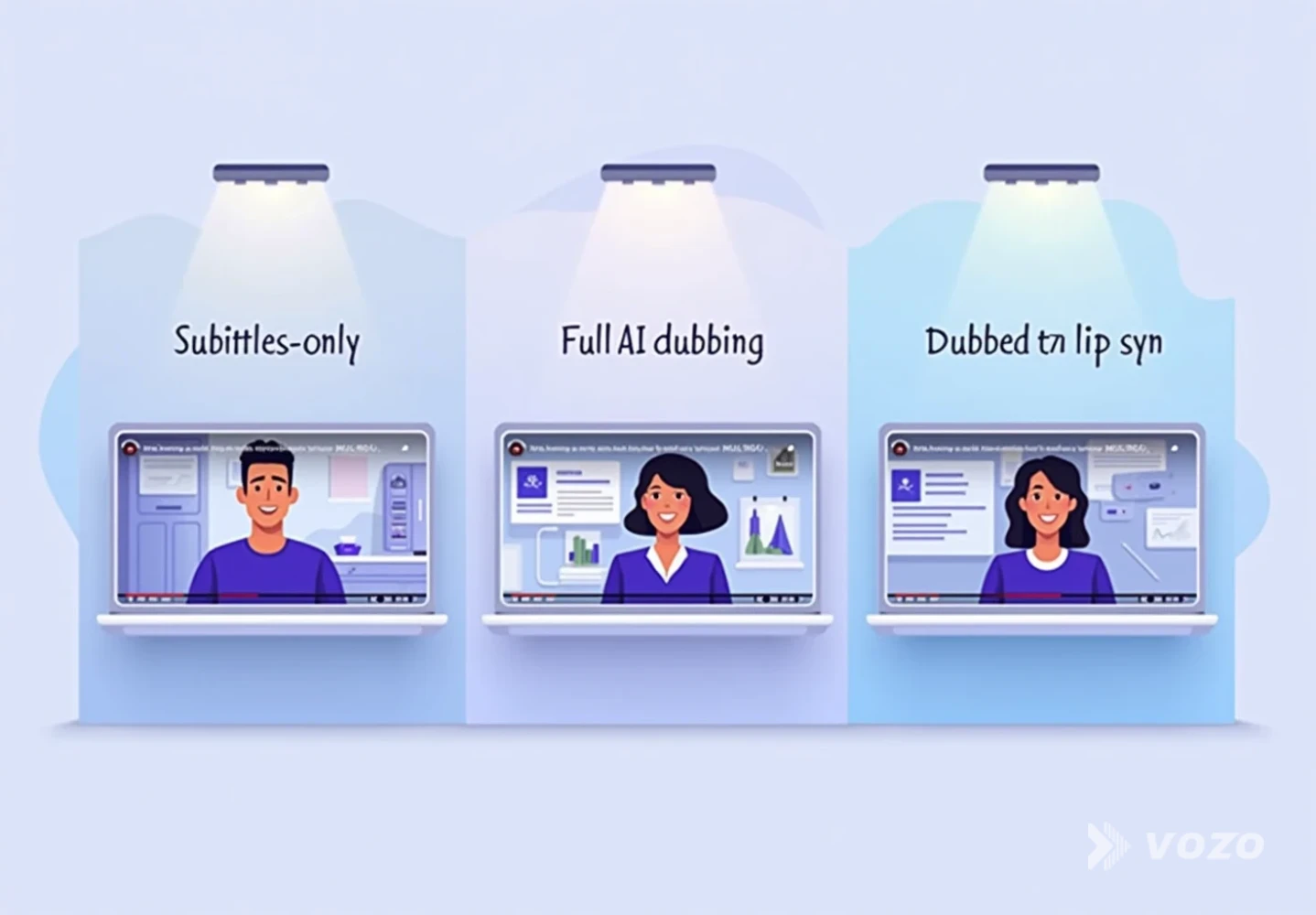
3) Audio strategy: subtitles vs dubbing vs lip sync
Your choice affects both cost and performance:
- Legendas: Fastest, lowest cost, and good for social and top-of-funnel testing.
- Dobragem: Often earns higher trust for product demos and mid-funnel viewing.
- Dubbing with lip sync: Best for founder-led videos, testimonials, and close-up speaking shots where mismatch can reduce credibility.
A practical editorial pick for this workflow is Vozo’s Tradutor de vídeo, which supports translation into 110+ languages with natural dubbing, optional voice cloning (VoiceREAL), optional lip sync (LipREAL), and a built-in proofreading editor for fast refinements.
4) On-screen text and UI handling
If your video shows app screens, checkout flows, or feature callouts on the screen, you need a plan. Sometimes you can replace overlays. Sometimes you re-render a short segment. Sometimes you use a localized version of the product page and reshoot that section. The key is to prevent the viewer from seeing a language mismatch at the exact moment they are trying to understand how to buy or how the product works.
5) QA and compliance checks
Localization increases risk if you ship inaccurate claims. A quick QA checklist usually includes numbers, units, and dates; shipping and warranty statements; and legal claims (especially in health, beauty, finance, and kids categories).
- Exatidão: Ensure translations match the source meaning and do not introduce new claims.
- Specifics: Validate units, ingredients, safety notes, and any technical specifications.
- Market reality: Confirm shipping speeds, return windows, and warranty terms for that region.
6) Measurement and attribution
At minimum, track performance per language and per market. Key metrics often include video view-through rate (VTR), product page add-to-cart rate, purchase conversion rate, refund rate, support tickets (language mismatch often shows up here), and revenue per localized variant.
A global KPI example report lists international conversion rate benchmarking around 2.50% for e-commerce, with market-to-market variance (GetBlend). That is a helpful baseline to compare localized versus non-localized funnels.
Product Video Translation ROI Data: A Simple Calculation
You can calculate product video translation ROI data with a straightforward formula:
ROI (%): (Incremental profit from localized markets minus localization cost) / localization cost x 100
To estimate incremental profit, combine incremental sessions from the market, conversion lift from localization (video plus language fit), average order value (AOV), and gross margin. When you want to be more conservative, include ongoing maintenance costs for updates, new SKUs, seasonal changes, and compliance edits.
Example (simple but realistic)
- Market: Germany
- Monthly product page sessions: 50,000
- Baseline conversion rate in English: 1.6%
- Conversion rate after localized product video plus localized page: 2.2%
- AOV: $75
- Gross margin: 55%
- Localization cost for a product video set: $2,500
Incremental orders per month: 50,000 x (2.2% minus 1.6%) = 300 additional orders
Incremental gross profit per month: 300 x $75 x 55% = $12,375
Payback period: $2,500 / $12,375 is about 0.2 months
Even if your lift is half of this, the payback can still be fast. That is why teams increasingly view ecommerce video localization ROI as a growth lever, not a cost center.
For broader context on localization ROI, one resource cites that localized websites can increase conversion rates by up to 70% (Translated.com). Actual results vary, but it frames why language-fit can create outsized returns.

Exemplos do mundo real
Example 1: Short-form discovery for cross-border traffic
A brand runs paid social in multiple countries but uses one English product video. After creating Spanish, French, and German variants (subtitles first, then dubbing for the winner), they typically see better hook comprehension, higher click-through to the product page, and reduced bounce caused by language mismatch. This aligns with a common 2026 best-practice pattern: test one market deeply, measure ROI per market, then scale winners (Taia).
Example 2: Complex setup product where trust matters
For products like espresso machines, skincare devices, or fitness tech, conversion often fails on “how it works” clarity. A localized approach that uses dubbing (and sometimes lip sync for a presenter), local units, local safety guidance, and translated on-screen steps often correlates with fewer pre-sale questions, higher add-to-cart, and lower returns from “not what I expected.” Vozo’s Dublagem AI can fit this use case because it targets tone, pacing, and emotion across 60+ languages.
Example 3: Scaling across a large SKU catalog
If you have hundreds of product videos, manual workflows break. Teams typically standardize scripts and a glossary, then use an API-based pipeline to automate translation, dubbing, and lip sync across uploads. Vozo’s API Vozo is designed for this type of integration when localization must plug into an existing content pipeline or marketplace workflow.
Benefícios e limitações
Localization can deliver strong returns, but it also introduces real operational and quality trade-offs. The best outcomes come from matching localization depth to product complexity and funnel stage, then measuring per market.
Benefícios
- Higher conversion where language is a barrier: Understanding features, sizing, and terms reduces purchase anxiety.
- Better performance from existing assets: Localization repurposes proven creative and reduces production overhead (Verbit highlights repurposing to maximize ROI).
- Faster market entry: Translation and dubbing can be faster than reshooting campaigns for every region.
- Stronger brand trust: Natural voiceover in the buyer’s language often feels more credible than subtitles alone, especially for demos.
- Clearer market-level measurement: Per-language variants make optimization and budgeting more systematic.
Limitações
- Quality risks: Literal translation can reduce clarity or introduce compliance issues, so QA matters.
- Visual mismatch slows production: UI screens and fine-print text can require extra editing or partial reshoots.
- Despesas gerais de funcionamento: More variants mean more version control, approvals, and ongoing updates.
- Not every product needs full depth: Impulse items may do fine with subtitles, while high-consideration products often benefit from dubbing.
How Ecommerce Video Localization Compares to Alternatives
| Aspeto | Localização de vídeo | English-only video | Local reshoots per market |
|---|---|---|---|
| Custo | Medium, scales well across languages and SKUs. | Low upfront, but can leave revenue on the table in non-English markets. | High, especially with talent, crews, and multiple locations. |
| Time to market | Fast to moderate, depending on audio choice and on-screen text. | Fast, since there is no extra production work. | Slow to moderate, scheduling and approvals add time. |
| Trust and clarity | High when dubbing and visuals match the market. | Variable, depends on local English fluency and product complexity. | Very high, cultural nuance can be strongest. |
| Escalabilidade | High, especially with standardized scripts and automation. | High operationally, but performance may cap in many markets. | Low to medium, each market is a new production project. |
| Melhor para | Testing and scaling into new languages with measurable ROI. | Markets with high English fluency and simple, low-risk products. | Top markets where ROI is proven and cultural nuance is critical. |
Actionable Best Practices to Improve International Conversion
These practices help push international video conversion rate ecommerce metrics in the right direction by focusing effort where it pays back fastest.
1) Localize your top 10 revenue drivers first
Start with the SKUs that already sell, not the ones you hope will sell. Proven products and proven videos reduce risk, and they usually deliver clearer lift signals during testing.

2) Match localization depth to funnel stage
- Prospecting ads: Start with subtitles, then test dubbing for the strongest markets.
- Product page videos: Dubbing often wins because it reduces friction at the decision point.
- Founder videos and testimonials: Dubbing plus lip sync can be worth it when face-to-camera credibility drives conversion.
3) Keep the first 3 seconds extremely literal
Hooks often lose meaning when they get clever in translation. Lead with the product and the promise in the simplest language possible, then layer in nuance later.
4) Adapt units, currency, and delivery claims
If viewers see “free shipping in 2 days” but that is not true in their region, conversion and trust both suffer. Align claims to actual regional operations, and make sure the product page matches the video.
5) Build a fast QA and revision loop
A built-in editor matters because speed affects iteration. Vozo’s Estúdio de voz (Reescrita de vídeo) is useful when you need to tweak a line, fix pronunciation, or refine a claim without re-recording from scratch.
6) Track performance per language and double down on winners
Measure conversion and revenue per market, then invest more in the languages that show the strongest payback. This matches the “double down on winners” approach described in localization scaling guidance (Taia).
Perguntas frequentes
What is the fastest way to test ecommerce video localization ROI?
Start with subtitles for one high-potential market and one high-performing product video. Measure lift in product page conversion rate, add-to-cart, and revenue per session versus an English control, then decide whether dubbing is justified.
Preciso de dobragem ou as legendas são suficientes?
Subtitles are often enough for short-form discovery content and cost-sensitive tests. Dubbing usually performs better for product demos, tutorials, and any content where tone and trust matter.
How many languages should I localize into first?
One to three. Many teams spread too thin early, which creates unclear results and operational chaos. A focused test produces cleaner ecommerce video localization ROI data and makes it easier to scale what works.
How do I measure translated product video sales impact if attribution is messy?
Use a mix of market-level lift (before and after localization), A/B tests on product pages (localized video versus English video), and UTM tracking for video-driven traffic. Validate with downstream signals like refund rates and support contacts, since misunderstanding often shows up after purchase.
What causes localization projects to underperform?
Common causes include poor source video clarity, overly literal translations, mismatched on-screen text, incorrect local claims (shipping or warranty), and failing to localize the product page to match the video. The fastest fixes are usually glossary control, QA, and aligning the video and page experience.
