

Updated as of June 2026: This guide reflects current AI voice copyright, disclosure, and platform-policy considerations for creators and businesses.
The Vacker v. ElevenLabs case, settled in 2025, showed how exposed creators and businesses can be when cloned voices are used without consent. The settlement demonstrated just how exposed creators and businesses are when using AI voices without properly understanding AI voice copyright, licensing agreements, and right of publicity protections. If you’re using AI voices for videos, podcasts, or AI video dubbing projects, you genuinely need to understand the legal framework before hitting publish—ignorance won’t protect you when lawyers come calling.
AI-generated voices exist at a complicated intersection of copyright laws, right of publicity statutes, and platform policies that are all still evolving. The U.S. Copyright Office has ruled that purely AI-generated content lacks copyright protection due to missing human authorship. Meanwhile, platforms now focus heavily on consent, impersonation, and disclosure. YouTube requires disclosure for realistic altered or synthetic content, Spotify removes unauthorized voice impersonation, and TikTok requires labels for realistic AI-generated media. OpenAI that will shape this industry for years to come. This guide explains the current legal landscape for artificial intelligence voices, platform policies, licensing structures, and compliance requirements for commercial use—so you know what you can legally do whether you’re dubbing videos into multiple languages or creating content for monetization.
Can You Copyright a Voice or AI-Generated Voice?
Understanding Copyright and Voice Protection
Can you copyright your voice? Under current federal copyright law, the answer is no—you cannot copyright a voice itself because voices aren’t works of authorship fixed in a tangible medium. The U.S. Copyright Office draws a clear distinction between your voice as a personal characteristic and recordings that contain vocal performances. An original recording of your voice performance receives copyright protection, but can a voice itself be copyrighted as an abstract characteristic? No. Copyright law protects original creative expressions—specific recordings, songs, audiobooks—not the inherent vocal qualities themselves.
This distinction becomes absolutely critical in the age of AI. When AI voice platforms generate synthetic voices or cloned voices, they’re creating new audio outputs rather than directly copying protected recordings. However, here’s where it gets tricky: unauthorized use of someone’s voice characteristics may still violate right of publicity laws, which operate completely separately from federal copyright. These publicity rights, governed primarily by state law rather than federal law, protect your likeness and voice from unauthorized commercial exploitation—even if copyright doesn’t cover it. So whilst you can’t copyright your voice, you might still have legal protection against someone cloning it without permission.
The Human Authorship Requirement in AI Content
The Copyright Office established through multiple rulings that copyright protection requires human creative authorship, meaning ai voices aren’t protected by copyright when generated purely by ai model algorithms. This doctrine emerged from cases like Burrow-Giles Lithographic Co. v. Sarony (1884) and continues through modern artificial intelligence cases including the Stephen Thaler Creativity Machine rejection.
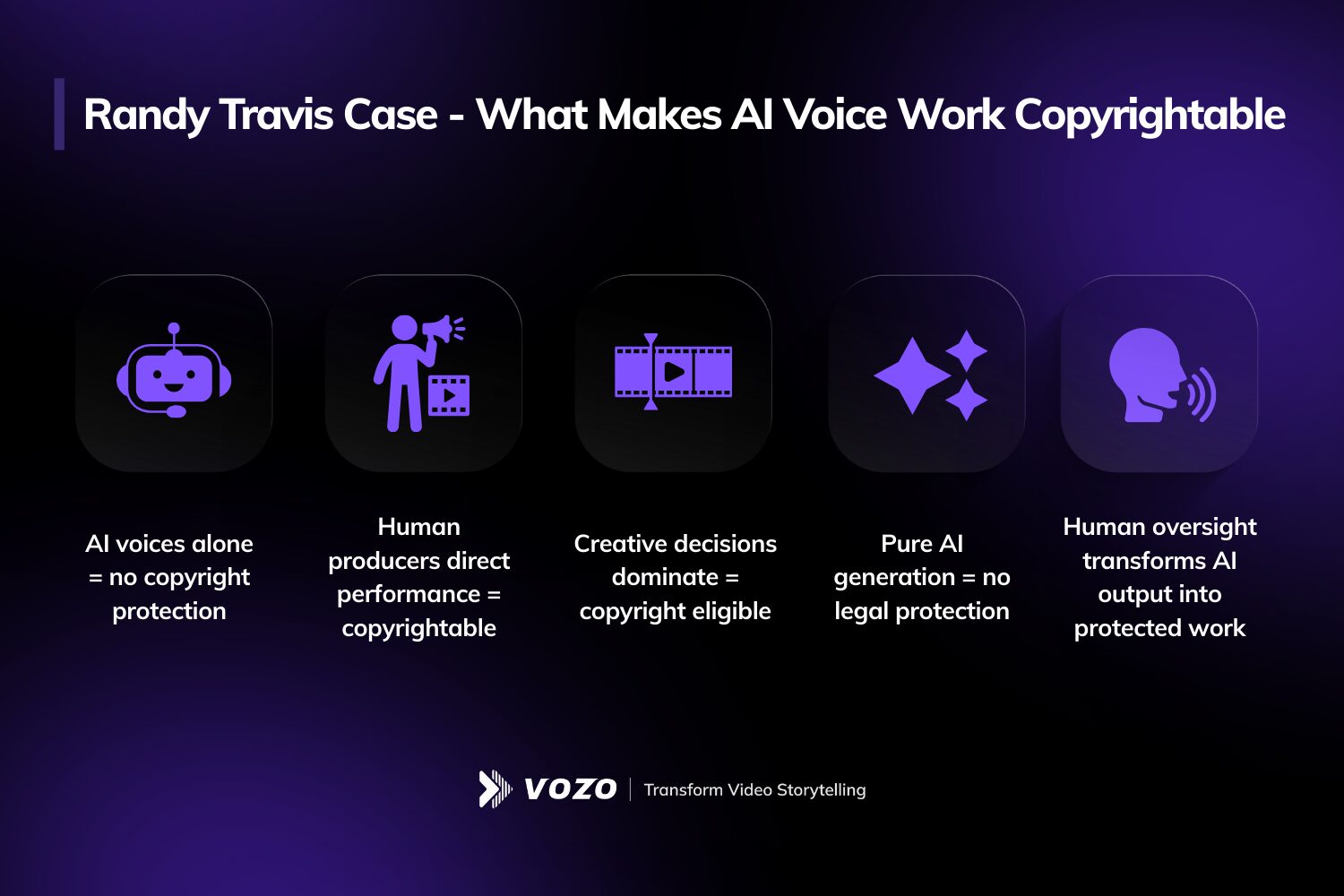
Randy Travis’s 2023 song “Where That Came From” demonstrates how understanding copyright applies to using an AI voice tool with human oversight:
- Human producers directed the vocal performance and arranged the instrumentation
- Creative decisions throughout production dominated the expressive elements
- The Copyright Office deemed the complete work copyrightable despite ai-generated vocals
- The ai-generated voice component alone received no protection as a work of authorship
- Human-directed production qualified for copyright while the AI voice did not
Who Controls AI Voice Ownership and Licensing?
Platform Ownership Models
Voice model ownership resides with AI voice provider companies under standard licensing agreements. Third-party AI voice platforms typically retain ownership of their underlying voice models while granting users usage rights through subscription or enterprise terms. For example, podcasting and voice tools may offer AI voices, voice cloning, or “revoice” features, but users do not own the underlying model unless the contract explicitly says so. Respeecher structures exclusive licensing agreements for voice clones, requiring explicit permission from voice owners before creating any replication. This permission-based approach contrasts with AI voice platforms that train their AI on publicly scraped data without individual consent.
Voice content created using AI technologies belongs to the creator, but the underlying synthetic voice model remains platform intellectual property. If you generate a podcast with Vozo AI’s translation service, you own the script, editing decisions, and final production, but Vozo AI retains ownership of the voice synthesis technology. This licensing structure parallels software as a service models where users access functionality without owning the underlying code.
Commercial License Structures and Rights
Personal-use licenses typically restrict monetization, business applications, and client work. Enterprise agreements unlock rights for commercial use including broadcast, advertising, product integration, and unlimited client projects. Vozo’s paid plans are designed for commercial video translation, dubbing, lip sync, subtitle translation, visual translation, and voice workflows. Users should still confirm that they have rights to the source video, script, likeness, and any cloned voice before publishing commercial content.
The distinction between licensed voices and unlicensed voice cloning affects legal risks dramatically. Licensed platforms provide clear terms of service, legal indemnification, and compliance documentation. Unauthorized commercial use of cloned voices from public data without consent creates liability for DMCA violations, publicity right infringement, and platform policy breaches.
Can You Monetize Content Using AI Voices?
Platform-Specific Monetization Policies
| Platform | Commercial Use | License Requirements | Disclosure Rules | Removal Triggers |
|---|---|---|---|---|
| YouTube Partner Program | Permitted | Proper licensing, no impersonation | Permitted when properly licensed and non-deceptive / disclose realistic altered or synthetic content in YouTube Studio / removal risk: impersonation, deceptive synthetic media, privacy or likeness complaints. | Deepfakes, unauthorized cloning, deceptive content |
| Spotify | Permitted | Licensed voices, transparency | Permitted when authorized / artist or creator voice impersonation requires permission / removal risk: unauthorized AI voice clones or deceptive impersonation. | Misleading content, copyright claims |
| Apple Podcasts | Permitted | No fraud or misrepresentation | Permitted when non-deceptive / avoid impersonation or manipulated audio that misleads listeners / removal risk: deceptive AI use, likeness abuse, copyright or trademark complaints. | Deceptive use, likeness and voice abuse |
| TikTok monetization / creator programs | Permitted | Original content, licensed voices | Label realistic AI-generated audio, video, or images when required by TikTok’s AIGC policy. | Imitation, harassment, fraud |
YouTube allows Partner Program monetization when you use AI voices if properly licensed and not used to imitate or impersonate. The platform’s policies prohibit deepfakes and manipulated media designed to mislead viewers but permit legitimate AI narration, dubbing, and character work. YouTube recommends labeling ai-generated content for transparency.
Spotify and Apple Podcasts require transparency when using AI and prohibit voice cloning that deceives listeners or impersonates a real person without authorization. Both platforms actively remove content violating personality rights or misrepresenting content origins. TikTok monitors voices through automated detection and manual review, removing content using voice cloning for impersonation, fraud, or harassment while allowing creative applications.
Commercial Licensing Verification
Verify where voices are sourced before commercial deployment. Legitimate platforms disclose whether voices are synthetic creations, consensual clones, or compilations from licensed voice talent. Services that can’t explain voice origins often use unauthorized training data that exposes users to copyright claims and publicity right lawsuits.
For video translation and dubbing, Vozo currently supports 111 source languages and 165 target languages. In broader marketing copy, use “160+ languages” to stay aligned with the website. Vozo also offers VoiceREAL and VoiceNATIVE voice cloning models, so teams can choose between preserving the original speaker identity and producing a more natural target-language accent.
How Do You Use AI Voices Legally and Ethically?
Legal Compliance Checklist
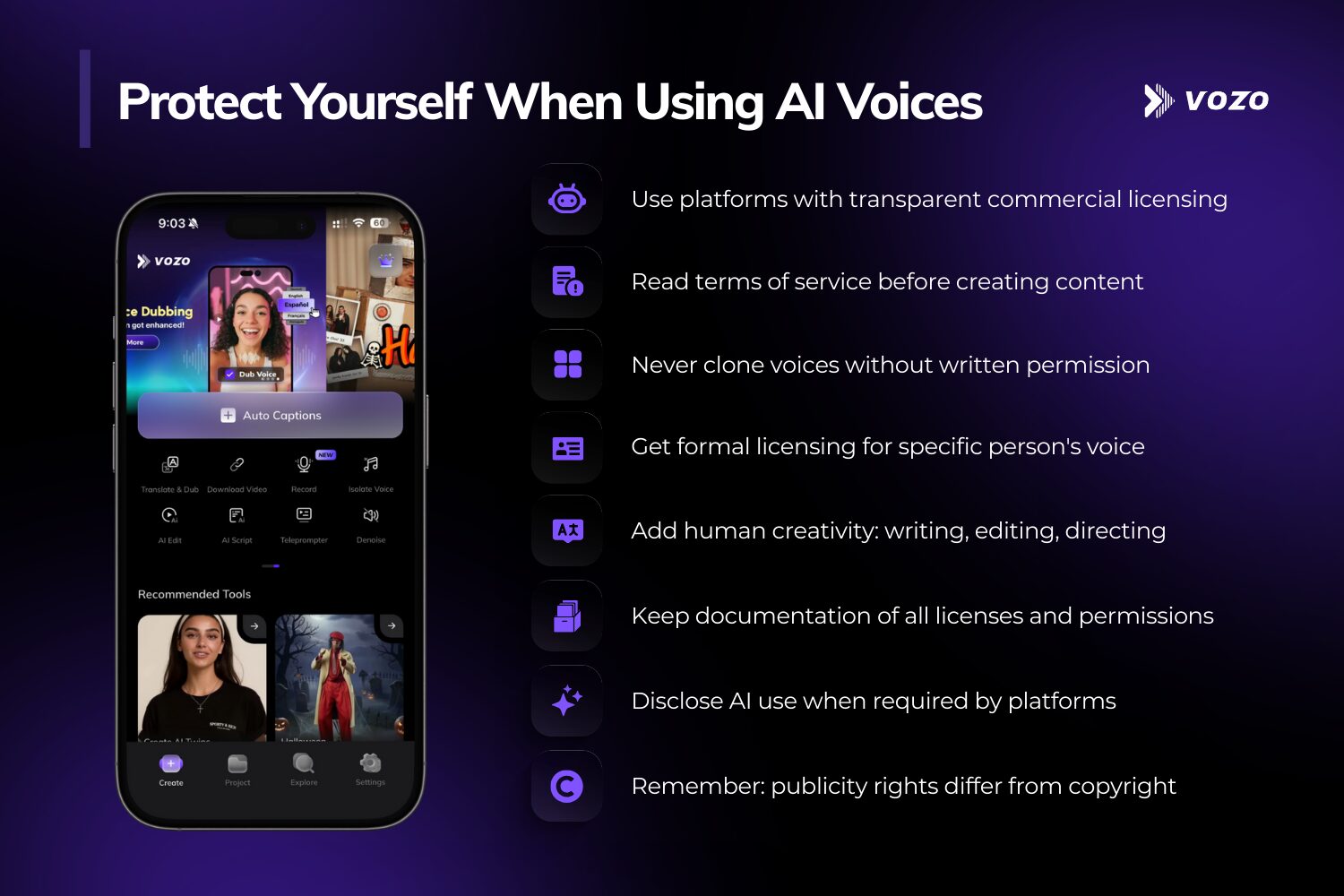
Following legal and ethical guidelines protects you from copyright infringement claims, publicity rights violations, and platform bans when using AI voice technology. The famous Midler’s voice case (Midler v. Ford Motor Co.) established that even imitation of distinctive vocal styles can violate publicity rights, demonstrating that voices are protected beyond just recordings.
Key compliance steps include:
- Choose platforms with transparent licensing that explicitly grants the right to use voices commercially
- Read terms of service completely before content creation, focusing on ownership clauses and commercial restrictions
- Never attempt to imitate or clone real people’s voices without explicit written permission from the voice owner
- Obtain formal licensing agreements specifying permitted uses, duration, compensation, and attribution requirements
- Add substantial human creative input through script writing, performance direction, editing choices, music composition, and quality control
- Remember that publicity rights lack broad fair use exceptions and some states treat voice as trademark-like intellectual property
- Understand that even content intended as parody may face legal challenges under state law protections
Documentation and Disclosure Requirements
Keep documentation of licensing agreements, permission forms, and terms of service for every AI tool. If challenged on usage rights, you need proof of proper licensing for legal defense. Save confirmation emails, download license certificates, and screenshot relevant terms of service sections. This documentation proves you’re free to use the technology within agreed parameters.
Disclose AI content when required by platform policies or regulations. YouTube recommends labeling ai-generated content while the EU mandates disclosure for AI outputs. Simple disclosures like “Narrated with AI voice technology” or “Translated using AI dubbing” satisfy requirements without undermining content value. Transparency addresses legal questions about whether the voice commercially deployed is authentic or synthesized.
Vozo AI’s Compliance Approach
Vozo AI provides licensed voice technology through our dubbing, translation, and lip sync services. Our approach ensures protecting voice rights of all parties involved. When you use Vozo AI for content creation, you’re working with voice content built on legitimate data sources with proper consent frameworks. This reduces risk compared with unverified voice scraping workflows, but creators should still confirm consent, source rights, and platform disclosure requirements for each project.
As of June 2026, Vozo offers two voice cloning models in Translate & Dub: VoiceREAL for preserving speaker identity and emotional tone, and VoiceNATIVE for more natural localized accents in ads, tutorials, e-learning, product explainers, and corporate videos.
Start Dubbing with Legal Protection
The legal landscape for AI voices combines copyright denial for purely ai-generated content, licensing models for commercial use, and right of publicity protections against unauthorized cloning. Operating successfully requires understanding these frameworks and choosing platforms with transparent licensing, legitimate training data sources, and clear commercial use rights that respect both copyright and personality protections.
Vozo provides licensed voice technology across dubbing, translation, and lip sync workflows, with 111 source and 165 target languages for Translate & Dub. Ready to scale multilingual content with clearer voice permissions and compliance practices? Start using Vozo for AI dubbing and video translation.
Are AI Voices Copyrighted? FAQs
What’s the difference between voice synthesis and voice cloning legally?
Voice synthesis creates artificial voices without replicating specific individuals, avoiding right of publicity issues entirely. Voice cloning replicates identifiable vocal characteristics of real people, triggering personality rights protections regardless of whether you have commercial licenses. Both lack copyright protection as purely ai-generated content, but cloning carries additional legal risks that synthesis avoids.
Can courts force AI companies to reveal their training data?
As of June 2026, AI transparency obligations continue to phase in under the EU AI Act and related regulations. Providers may face disclosure, documentation, or training-data-summary requirements depending on their role, market, and system type.
Will the NO AI FRAUD Act change how I can use AI voices?
As of June 2026, the NO AI FRAUD Act remains an important proposal rather than settled federal law.
The proposed NO AI FRAUD Act would create federal protections against unauthorized AI voice recreations if passed by Congress. This legislation would establish clearer liability standards for platforms and users, potentially requiring more stringent permission processes for voice cloning. While not yet law, the bill indicates future regulatory direction toward stronger personality rights enforcement and stricter platform accountability.
Do I need to disclose AI voices on YouTube, TikTok, Spotify, or Apple Podcasts?
Often, yes, especially when the voice could be mistaken for a real person or materially alters what a real person appears to say. YouTube requires disclosure for realistic altered or synthetic content, TikTok requires labeling for realistic AIGC, and Spotify/Apple Podcasts prohibit deceptive impersonation or unauthorized voice cloning. When in doubt, disclose and keep proof of voice rights.
Back to Top: Are AI Voices Copyrighted? Legal Guide for Creators & Businesses
