

A successful ecommerce video rarely becomes valuable because of one language version alone.
For global brands, a single product video can become part of multiple customer touchpoints: paid ads, product pages, marketplace listings, social media campaigns, and creator-driven promotions. Once a creative has proven its ability to attract attention and explain a product effectively, the next challenge is not always creating a new video from scratch. It is adapting that existing asset for different markets.
This is where many ecommerce teams face a production challenge. A video that works well in one market may still require adjustments before it can perform effectively elsewhere. This process involves adapting language, product messaging, and visual elements inside the video through a structured ecommerce video localization workflow.
The goal is to create a localized version that preserves the original creative intent while making the content feel natural for a new market. For ecommerce teams expanding internationally, this shift changes video localization from a one-time translation task into a repeatable creative workflow.
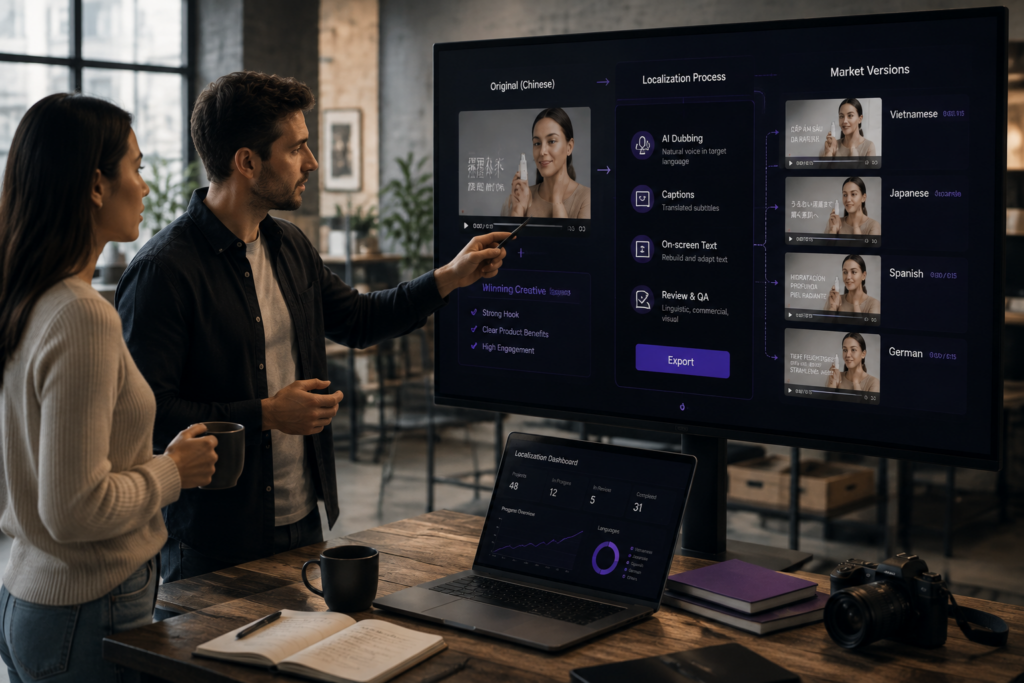
Ecommerce Video Ads Are Becoming Reusable Global Assets
In many ecommerce businesses, video production starts with a specific market objective: launching a product, testing a new offer, or promoting a seasonal campaign.
However, successful creatives often have a longer lifecycle. A product demonstration that performs well in one region may contain elements that are valuable across multiple markets:
- the product explanation
- the demonstration structure
- the customer problem being addressed
- the creator’s presentation style
- the visual proof of product benefits
Instead of treating each market as a completely separate production project, many global ecommerce teams are looking for ways to reuse existing creative assets while adapting the parts that need to change.
This approach is especially relevant for:
- direct-to-consumer brands expanding internationally
- cross-border ecommerce companies entering new regions
- teams managing multiple paid advertising markets
- agencies producing localized campaigns for multiple clients
The challenge is finding the right balance.
If a brand changes too little, the video may feel translated rather than created for the target audience. And if a brand changes too much, the original creative advantage may be lost.
Effective localization sits between these two extremes: keeping what already works while adapting what affects audience understanding and purchase decisions.
Why Adapting Ecommerce Videos Requires More Than Translation
A common assumption is that entering a new market only requires translating the spoken content and subtitles. For ecommerce videos, this is rarely enough.
A product video communicates through multiple layers at the same time. Customers do not only listen to what is being said; they also interpret what they see, how information is presented, and whether the message matches their expectations.
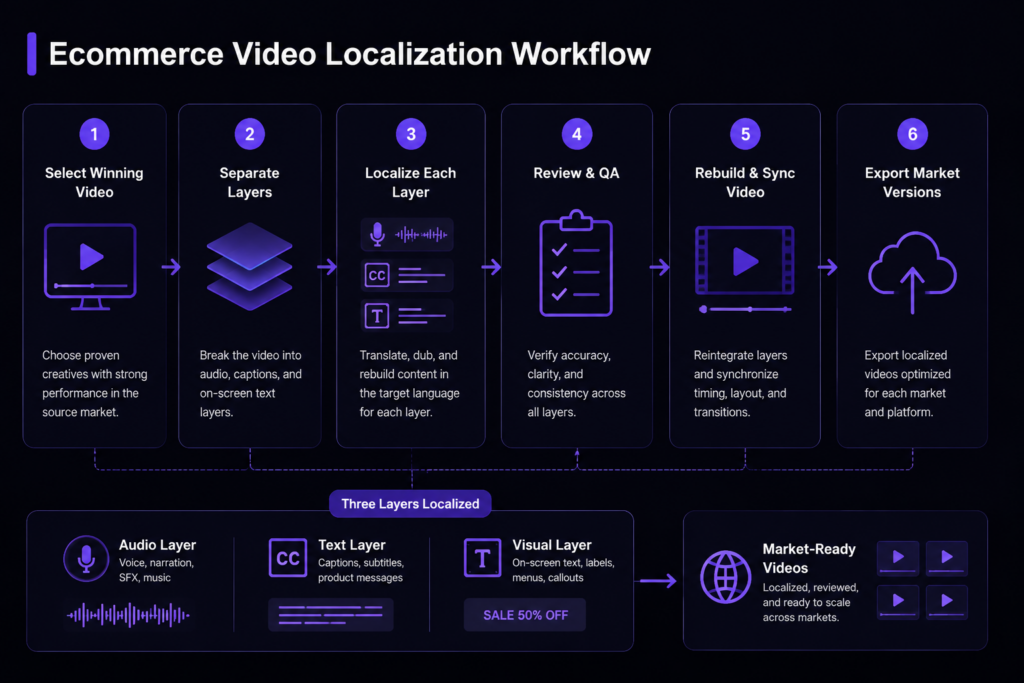
A scalable localization workflow usually needs to consider three different layers.
1. Audio and Voice Layer
The spoken part of a video carries more than information. For brands using creator-led ecommerce videos, maintaining natural voice delivery across languages can be important for preserving audience trust. AI dubbing workflows can help teams adapt spoken content while keeping the original communication style.
Voice affects:
- trust
- emotional tone
- creator authenticity
- product explanation style
For example, a product recommendation video from a creator depends heavily on natural delivery. A direct translation may preserve the words but lose the original communication style.
For ecommerce brands using UGC-style advertising, maintaining a natural voice experience is particularly important because the creator’s personality is often part of why the original content works.
The goal is not only to make viewers understand the language. The goal is to preserve the feeling that the content was made for them. For videos featuring visible speakers or creators, maintaining natural lip sync across languages can further improve the localized viewing experience.
2. Caption and On-Screen Text Layer
Many ecommerce videos contain important information directly inside the frame, including product benefits, feature highlights, promotional messages, comparison points, and calls to action. For global campaigns, brands often need to adapt these visual elements together with audio and captions through video text translation and visual localization.
These elements are often separate from the spoken audio.
A translated voiceover alone does not create a complete localized experience if viewers still see untranslated text from another market. This is especially common in:
- product demo videos
- short-form ads
- marketplace videos
- social commerce creatives
For global ecommerce teams, visual text adaptation is often one of the most overlooked parts of localization.
3. Product and Commercial Context Layer
The final layer is not linguistic. It is commercial. A product message that works in one market may require adjustment in another because customers may evaluate products differently. Teams need to review:
- product descriptions
- claims and terminology
- offers
- pricing references
- customer expectations
Localization should maintain product accuracy while making the message relevant for the target audience.
This is why ecommerce video localization requires coordination between marketing, product, and localization teams rather than being treated as a simple translation task.
The Better Approach: Adapt Proven Creatives Instead of Starting Over
For many ecommerce teams, the most efficient localization strategy starts with existing successful content.
Instead of rebuilding every market version from zero, teams can identify which parts of a video should remain consistent and which parts should be adapted. This approach is also changing how teams think about modern AI video translation workflows, where multiple localization layers can be managed together.
A practical approach is:
Keep the elements that already proved effective:
- product demonstration structure
- visual storytelling
- customer problem
- core value proposition
Adapt the elements that affect local relevance:
- language
- voice delivery
- captions
- embedded visual text
- market-specific messaging
This approach allows teams to scale creative assets without losing the original reason the video worked. For example, a product explainer created for one market may already have the right:
- product angle
- demonstration sequence
- customer education flow
The localization process can focus on adapting the communication layer instead of recreating the entire production pipeline.
A Practical Workflow for Repurposing Ecommerce Video Ads Globally
A repeatable workflow helps ecommerce teams maintain consistency while producing multiple market versions.
Step 1: Identify the Creative Assets Worth Localizing
Not every video needs to be localized. Teams should first identify content with proven value:
- high-performing product videos
- successful UGC creatives
- product explainers
- campaign assets that already match brand positioning
The purpose is to maximize the value of existing creative investments.
Step 2: Separate the Video Into Localization Layers
Before adapting a video, teams should separate different content components:
Voice layer
- spoken content
- narration
- creator delivery
Text layer
- subtitles
- captions
- on-screen messages
Visual layer
- product labels
- graphics
- embedded text
This separation makes the localization process more controlled and easier to review.
Step 3: Adapt the Content for the Target Market
The localization stage focuses on making the video suitable for the new audience. This may include:
- translating product explanations
- adapting terminology
- rebuilding visual text
- adjusting voice output
- reviewing the final message
For ecommerce teams, consistency matters because multiple localized versions should still represent the same brand identity.
Step 4: Run Quality Checks Before Launch
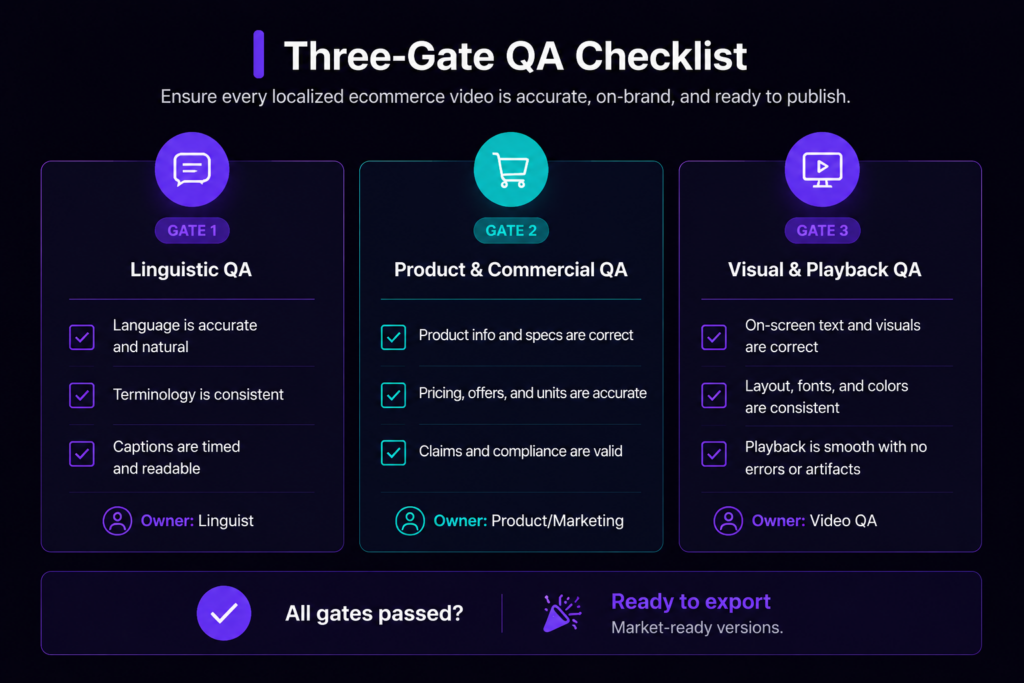
A localized video should be reviewed from multiple perspectives. A complete review process typically includes:
- Linguistic reviewDoes the translated content sound natural and accurate?
- Product and commercial reviewAre product details, claims, and messaging correct?
- Visual and playback reviewAre captions, text elements, timing, and final rendering correct?
This multi-layer review helps prevent situations where a video is technically translated but commercially inaccurate.
How Video Localization Technology Supports Ecommerce Creative Operations
As ecommerce brands expand into multiple markets, the challenge is not only producing localized videos. It is building a repeatable process that allows marketing teams to create and manage different versions efficiently.
Traditional localization workflows often involve multiple separate steps:
- transcript preparation
- translation review
- voice recording
- subtitle creation
- visual editing
- final quality checks
When brands only need one localized version, a manual process may be manageable. However, when teams need to adapt multiple videos for multiple markets, production complexity increases quickly.
A scalable workflow requires tools and processes that can handle repetitive localization tasks while keeping human review involved where it matters most. AI video localization can support this process by helping teams accelerate areas such as:
- multilingual video adaptation
- voice generation and dubbing workflows
- subtitle creation
- visual text translation
- version production
The purpose of AI is not to replace marketing decisions. A successful ecommerce campaign still depends on human understanding of:
- customer behavior
- product positioning
- market expectations
- brand communication
AI helps reduce repetitive production work so teams can spend more time optimizing creative strategy.
Example Workflow: Adapting Ecommerce Videos for a New Market
A practical localization workflow can be seen through internal production experiments and sample adaptation processes.
For example, when preparing product videos for a Vietnamese market, the process may involve:
- selecting existing product explainers and ecommerce videos
- preparing localized versions for the target audience
- reviewing translated content
- checking product information and visual consistency
- exporting market-ready versions
In one six-day Visual Translate sample workflow, 101 visible projects were reviewed, with six Vietnamese target videos selected, including three product explainers and three ecommerce videos. Five completed exports were produced during the sample process.
The workflow focused not only on translation accuracy but also on ensuring that localized videos remained consistent across three review areas:
- linguistic accuracy
- product and commercial accuracy
- visual and playback quality
This reflects an important principle for ecommerce localization: A translated video is only successful when the final content still communicates the product correctly.
Common Mistakes When Scaling Ecommerce Video Ads Globally
Creating multiple market versions of an ecommerce video introduces new challenges. Some common mistakes happen when teams focus only on speed and overlook the details that influence customer understanding.
Mistake 1: Treating Localization as Subtitle Replacement
Subtitles are an important part of video localization, but they represent only one communication layer.
A video may still contain:
- untranslated text overlays
- original language product screenshots
- outdated promotional messages
- inconsistent terminology
A complete localization process needs to consider every element customers see and hear.
Mistake 2: Changing Too Much Instead of Preserving Proven Creative Elements
When adapting content for a new market, teams may assume that everything needs to be recreated.
However, the original creative may already contain valuable elements:
- effective storytelling structure
- product demonstration sequence
- customer education approach
The purpose of localization is not to discard successful creative decisions. It is to adapt them for a new audience.
Mistake 3: Ignoring Commercial Accuracy
A video can be linguistically correct but still create problems if product information is inaccurate.
Examples include:
- incorrect product terminology
- inconsistent feature descriptions
- unclear promotional information
- unsuitable claims
For ecommerce brands, accuracy directly affects customer trust.
Localization review should therefore involve more than language checking.
Mistake 4: Creating Every Market Version as a Separate Production Project
A common scaling challenge is rebuilding each market version independently.
This approach increases:
- production time
- creative management complexity
- review workload
A more efficient approach is creating a localization system where existing assets can be adapted repeatedly.
Building a More Scalable Ecommerce Video Localization System
As ecommerce brands continue expanding internationally, video content is becoming a reusable business asset rather than a one-time marketing output.
A scalable system allows teams to:
- Identify high-performing creatives. Focus localization resources on content that already demonstrates market potential.
- Create consistent adaptation workflows. Maintain brand messaging while adjusting content for local audiences.
- Manage multiple versions efficiently. Support different languages, markets, and campaign requirements without rebuilding every asset.
- Maintain quality control. Ensure localized content remains accurate across language, product, and visual elements.
For ecommerce teams, the long-term advantage is not simply producing more videos.
It is creating a system where successful creative assets can continue generating value across markets.
Final Thoughts
Global ecommerce growth requires more than translating existing advertisements into different languages.
Successful market expansion depends on adapting content in a way that preserves the original creative value while making the message relevant for new customers.
For ecommerce teams, the most effective approach is to treat video localization as part of the creative production process:
- keep proven ideas
- adapt market-specific elements
- review commercial accuracy
- scale successful assets across regions
Instead of rebuilding every campaign from scratch, brands can create a more efficient way to extend their best-performing video content into new markets.
