

Multilingual video content has shifted from a secondary option to a core growth strategy for YouTube creators and corporate teams chasing international markets. E-learning platforms treat localized audio as a baseline requirement, not a feature.
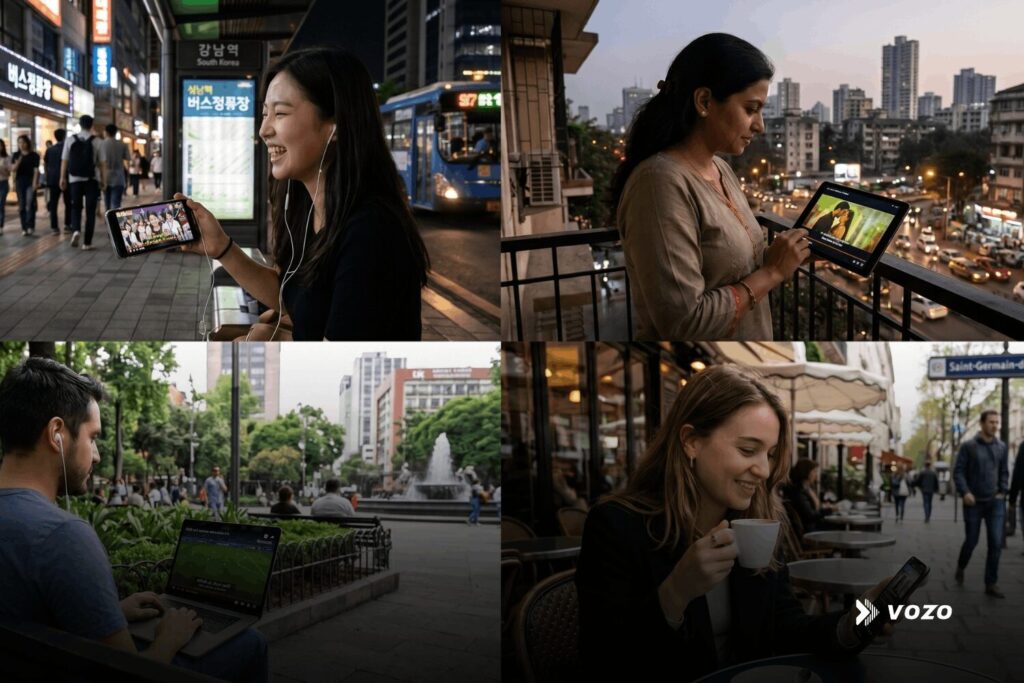
Many viewers prefer localized audio content over captions. Localized audio removes the need to read subtitles, helping viewers stay immersed in visuals without on-screen text pulling their attention away.
AI dubbing can cut weeks-long lead times down to days, letting brands synchronize global launches and react to trends much faster. Back catalogs, internal training videos and long-tail social campaigns that studios couldn’t justify dubbing are now financially viable. AI voice dubbing finally makes deep-catalog localization truly scalable.
What is AI Voice Dubbing?
AI video dubbing is the automated process of replacing a video’s source audio track with a machine-generated vocal equivalent in a target language. No casting director or scheduling delay slows the process down.
Unlike traditional dubbing, which routes content through studios and professional voice actors, AI dubbing compresses that entire workflow into software. Automatic speech recognition (ASR), neural machine translation (NMT) and voice cloning operate in sequence inside a single pipeline.
Voice cloning lets the system approximate the original speaker’s voice, preserving timbre and pacing so speaker identity holds across markets.
How does AI Dubbing Work?
AI dubbing replaces manual studio workflows with a unified neural pipeline. Every stage feeds the next with time-aligned data, helping preserve original timing and speaker characteristics throughout the pipeline. The result is a localized audio and video asset that feels native rather than processed.
Transcription (Speech-to-Text / Asr)
Automatic speech recognition (ASR) converts original audio into a time-stamped text transcript.
The transcript anchors every downstream stage and sets the quality ceiling for the entire pipeline. Errors introduced here compound through machine translation and voice synthesis, producing a final dub that post-production struggles to salvage.
Heavy background noise and overlapping speakers reduce overall ASR accuracy before the dubbing workflow even begins. ASR engines trained on domain-specific vocabulary consistently outperform general-purpose models on technical or regulated content.
Machine Translation
Machine translation (NMT) models process the finalized transcript and account for context and domain-specific terminology.
Rather than substituting words directly, NMT reshapes complete sentence structures to fit the target language naturally and idiomatically. For high-stakes content, human reviewers refine cultural nuance before the text advances to voice synthesis.
Dialogue in a different language needs to land naturally, not just accurately. Glossaries and style guides built into the workflow prevent brand-specific language from being flattened by automated tools. Brands working across regulated industries benefit most from combining NMT output with structured human review.
Voice Generation (Text-to-Speech and Voice Cloning)
AI voice engines convert translated text into natural-sounding speech that closely mirrors the original speaker’s voice. Many modern systems support zero-shot voice cloning, approximating the original speaker’s timbre and pacing without additional recordings.
A quality voice generator helps preserve brand and speaker consistency across all language versions. Various voice libraries give teams the flexibility to match presenter styles and regional accents as each project demands.
Character-driven content benefits most from precise voice matching and consistency across every dubbed language version. Anime productions in particular rely on consistent character voices across every localized release to maintain audience connection.
Lip‑sync and Audio Alignment
The system aligns the new voice track to on-screen timing and lip movements for a natural result. Generated audio stretches or compresses automatically to match the original scene cuts and speaker motion as closely as possible.
Visual AI adjusts mouth frames to better match phonemes of the new language in advanced workflows. Precise synchronization between dubbed output and on-screen action separates polished localization from an obvious audio swap.
Viewers should ideally register no difference between the original audio and the dubbed replacement. Tightly aligned audio and video keep audiences focused on content rather than distracted by synchronization errors.
Review and Post‑production
Editors run a final quality pass across translation accuracy and audio track balance before export. Teams flag and correct obvious translation issues at this stage, reducing the risk of problems surfacing after delivery.
The voice dubbing output gets smoothed against music and sound effects so the final mix sounds intentional. Finished assets move to the required export formats, ready for platform upload or broadcast integration.
For teams running a dubbing studio workflow at scale, structured post-production converts solid automated output into a professional-grade deliverable that clears broadcast requirements.
AI Dubbing vs Traditional Dubbing: What’s the Difference
Choosing the right dubbing approach depends on scale, budget and content priorities. AI dubbing serves high-volume distribution where speed and cost efficiency matter most. Traditional dubbing remains the benchmark for emotionally complex, high-stakes creative production.
| Feature | AI Dubbing | Traditional Dubbing |
|---|---|---|
| Production process | Automated, software-driven pipeline | Manual, studio-based with voice actors and engineers |
| Turnaround time | Hours to days, even at a multi-language scale | Weeks to months for multiple language versions |
| Cost | Fraction of full studio rates | Higher, driven by talent fees and studio overhead |
| Voice consistency | Highly consistent across all languages | Varies by local talent and casting choices |
| Nuance and acting | High and improving, but still evolving | Stronger emotional nuance when the right talent is cast |
| Best-fit scenarios | Scaling catalogs, training videos and social content | Feature films, prestige series and high-end TV |
Benefits of AI Voice Dubbing
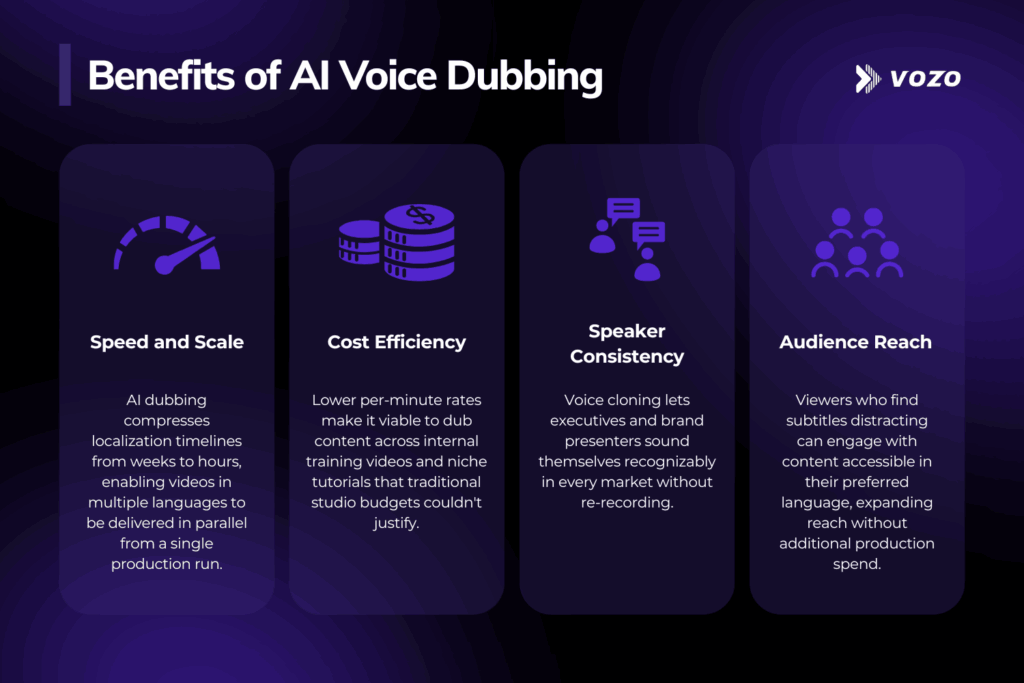
AI voice dubbing gives content teams a measurable production advantage. Modern AI dubbing pipelines remove the bottlenecks that slow down multilingual releases. The four benefits below reflect what teams gain when localization moves into an automated pipeline.
- Speed and scale: AI dubbing compresses localization timelines from weeks to hours, enabling videos in multiple languages to be delivered in parallel from a single production run.
- Cost efficiency: Lower per-minute rates make it viable to dub content across internal training videos and niche tutorials that traditional studio budgets couldn’t justify.
- Speaker consistency: Voice cloning lets executives and brand presenters sound themselves recognizably in every market without re-recording.
- Audience reach: Viewers who find subtitles distracting can engage with content accessible in their preferred language, expanding reach without additional production spend.
Common Use Cases for AI Dubbing
Localized audio creates a measurable difference in engagement across every content vertical. Automated voice dubbing delivers the strongest return where compliance, audience reach and production speed are the primary goals.
- E-learning and training: Videos for employees covering compliance and onboarding can be localized into every learner’s native language, so the core message lands consistently across global teams.
- Marketing and product videos: Launch explainers and social campaigns can ship in a different language on or near day one, rather than weeks after the original release.
- Creators and influencers: YouTubers and streamers can extend their videos with AI dubbing into additional languages without re-recording, unlocking new regions and global audiences.
- Corporate communications: Leadership updates and investor messaging feel direct when delivered in the listener’s language, removing the distance that translated captions create.
- Large content catalogs: Media libraries can add localized audio track versions to back-catalog titles, making content accessible to new markets at costs traditional studios can’t match.
Limitations of AI Dubbing to Consider
AI dubbing performs well across a wide range of content types, but specific scenarios expose current boundaries. Teams that understand those limits set more accurate expectations before committing to an automated pipeline.
- Emotional range: AI can struggle with deep emotional nuance and comedic timing, sometimes requiring human adjustment of prosody across tone and emphasis.
- Cultural accuracy: Literal translations miss idioms and brand-specific language and glossaries aren’t built into the workflow. Techniques for translating and dubbing at a professional level require structured human oversight to ensure culturally sensitive content.
- Input quality: Heavy background noise and overlapping voices directly competing on the same audio track reduce ASR accuracy and degrade the final dub.
- Ethics and rights: Consent and legal authority to clone and reuse a voice are non-negotiable for commercial content creation. Voice data storage policies require careful review before any AI dubbing tool goes live.
How to Choose an AI Dubbing Solution
The right AI dubbing tool integrates with your existing workflow and gives your team meaningful control over output quality. Evaluate each solution carefully. Not every platform covers the languages your audience actually speaks.
- Language coverage: Confirm not just headline languages but relevant regional variants. Hindi, Arabic, Tamil and Portuguese each carry distinct phonetic and cultural requirements that generic coverage may not address.
- Voice capabilities: A strong dubbing AI app offers robust voice options and voice-cloning controls, with support for pacing adjustments so the output sounds crafted rather than generated.
- Quality controls: A professional AI video dubbing tool should include an in-platform transcript editor and support for a custom brand dictionary, with optional human review steps.
- Workflow fit: The dubbing studio solution needs to integrate with your existing video platforms and file formats without adding friction to handoffs or exports.
- Security and compliance: Review how the provider stores and governs access to your content and cloned voice assets. Regulated industries where original audio and speaker data carry legal weight require especially careful vetting.
Take Your Content Global With Vozo AI
AI voice dubbing has moved from a niche experiment to a practical way to scale multilingual video without rebuilding your entire production workflow. Speed and cost efficiency give teams what they need to localize everything from training libraries to launch campaigns at the pace global audiences now expect.
Speaker consistency across markets seals the advantage. Vozo AI was built around this reality. Its AI dubbing platform combines transcription and voice cloning into a single pipeline, so your team can turn a single source video into high-quality localized versions in just a few steps.
If you want to see how it works on your own content, Vozo AI offers a free trial to get you started.
What Is Dubbing AI?: A Guide to AI Voice Dubbing
Can AI Dubbing Handle Multiple Speakers in One Video?
Modern AI dubbing systems automatically identify and separate multiple speakers. Each speaker gets assigned a distinct cloned voice that carries through the full video. Speaker consistency holds across every language version without manual reassignment between scenes.
Does AI dubbing work with accented or non-native speech?
AI dubbing can process accented and non-native speech, but ASR accuracy drops when the accent is heavy or the model wasn’t trained on that variation.
A transcript-correction step before voice synthesis catches errors that automated recognition misses. Teams working with regional accents should factor that review stage into their production timeline.
How long does voice cloning require for source audio?
Zero-shot voice cloning can work with as little as a few seconds of clean audio. Thirty to 60 seconds of source material typically produces more accurate timbre and pacing replication. Background noise or overlapping audio during recording reduces cloning precision regardless of clip length.
Back to Top: What is Dubbing AI?: A Guide to AI Voice Dubbing
